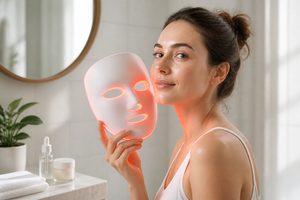
You keep seeing the word on product pages, in esthetician videos, and in the fine print of every LED mask you have been comparing. It sits next to promises about collagen, smoother texture, and clearer skin, with almost no plain explanation attached. If you are trying to decide whether an at-home light device deserves a spot on your bathroom shelf, the term deserves a real answer first.
Photobiomodulation is the use of specific wavelengths of visible or near-infrared light to change how skin cells behave, and in cosmetic skincare that means supporting collagen production, a more even-looking tone, and calmer, less oily-looking skin. It is the scientific name behind what most people call red light therapy. Light-emitting diodes, better known as LEDs, are the delivery method in nearly every at-home device sold today.
This guide covers how light gets absorbed by your cells, why numbers like 620nm and 460nm appear on device packaging, and what results are reasonable to expect. By the end, you will be able to read any LED device listing and judge whether its wavelengths, session length, and coverage actually match your skin goals.
How Photobiomodulation Works on Skin Cells
Light does something to skin cells that has nothing to do with heat. In photobiomodulation, specific wavelengths pass into the skin and get absorbed by molecules inside your cells, which then changes how those cells make energy.
That absorption step is pure photochemistry. Molecules that absorb light are called chromophores. Skin holds several of them, and the one researchers point to most often sits inside the mitochondria, the small structures that power every cell you have.
Photobiomodulation is nonthermal. Your skin does not get hot, and nothing is removed or injured. The light gives cells a signal, and the cells respond by working differently for a period of time afterward.
From Light Absorption to Cellular Signaling
Once light is absorbed, a chain of internal signals begins. Cells release small amounts of nitric oxide and switch on the genes involved in repair.
Those signals are the bridge between a ten-minute light session and any visible change weeks later. They influence how cells repair themselves, how often they divide, and how much structural protein a fibroblast decides to build.
This is why one session does very little on its own. The signal is real but short-lived, so repeated exposure over months is what research on red and blue LED light therapy consistently studies.
Mitochondria, Cytochrome c Oxidase, and ATP Production
The main target is an enzyme called cytochrome c oxidase, which sits inside the mitochondria. It absorbs red light well, and that absorption speeds up the way mitochondria produce energy.
The practical result is more adenosine triphosphate, or ATP, the fuel cells use for every job they do. More available ATP means more mitochondrial activity overall.
Skin cells with more energy handle repair and turnover better. That is the mechanism behind claims about firmer-looking skin, since collagen-producing cells need energy to build anything.
Why Dose Matters in Photobiomodulation
Photobiomodulation follows what researchers call a biphasic dose response. Too little light does nothing noticeable, and too much can suppress the same cellular activity you were trying to encourage.
Dose is built from a few variables working together:
- Wavelength, measured in nanometers, which determines what gets absorbed and how deep the light reaches
- Irradiance, the power delivered per unit of skin area
- Exposure time, how long the light stays on the skin
- Session frequency, how many times per week you repeat it
- Total treatment period, usually measured in months for cosmetic goals
Home devices handle this by fixing the variables for you. A 10-minute automatic shutoff, for example, removes the guesswork about exposure time entirely.
Those numbers on the box start to mean something once you know what each one controls.
Why Wavelength, Irradiance, and Exposure Time Matter
Wavelength decides which cells respond and how deep the light travels. A nanometer is one billionth of a meter, and the number on a device tells you the exact color of light being emitted.
Shorter wavelengths like blue light stay near the surface of the skin. Longer wavelengths like red light travel deeper into the dermis, where collagen-producing cells live. Dermatology research describes red light as roughly 620 to 700 nanometers of the visible spectrum.
Irradiance and exposure time together produce fluence, also called energy density. Fluence is the total light energy your skin receives during a session, and it is the figure clinical studies report when describing a treatment dose.
What 620nm Red Light Does for Skin
Red light at 620nm is used for the appearance of fine lines, uneven tone, and rough texture. It reaches the dermis, where fibroblasts build collagen and elastin.
The cosmetic reasoning follows the mechanism already described. More ATP available to fibroblasts supports the work of producing structural proteins, which affects how firm and smooth skin looks over time.
Wearable devices apply this directly. PlushDerm’s 620nm red light therapy setting is built around these goals, and each cycle runs 10 minutes before shutting off automatically. Individual results may vary.
What 460nm Blue Light Does for Skin
Blue light at 460nm targets acne-causing bacteria near the skin surface. It works through a different pathway, reaching compounds produced by those bacteria rather than the mitochondrial enzymes deep in the dermis.
Because blue light stays shallow, it suits oiliness and blemish-prone skin more than wrinkle goals. Published research on self-applied blue light for mild-to-moderate facial acne is the kind of evidence behind consumer 460nm blue light therapy modes. Individual results may vary.
Laboratory work on human skin cells also found that blue light can inhibit pro-collagen production in some cell populations. That is one practical reason devices keep the two wavelengths in separate modes rather than running them as one.
How Fluence and Device Design Affect Light Delivery
Device design determines how much of the stated wavelength your skin actually receives. Distance from the skin, LED spacing, and coverage area all change the real fluence, no matter what the box says about power output.
A mask that sits flush against skin delivers light more consistently than a panel held at arm’s length. Coverage matters too, since light only affects the area it reaches.
This is where face-and-neck coverage becomes a practical design question. A system that includes a separate face and neck device treats both areas in one 10-minute session.
Knowing the delivery mechanics is one thing. What that light can realistically do to the way your skin looks is another.
What Photobiomodulation Can Realistically Do for Your Skin
Expect gradual, modest changes in the appearance of fine lines, tone, texture, and oiliness over months of consistent use. Dermatology research supports the direction of these effects, though outcomes differ from person to person.
Harvard Health reports that the American Academy of Dermatology considers many at-home LED and low-level laser devices safe, and that research suggests red light therapy can reduce fine lines and smooth skin texture. The same article notes devices must be used multiple times a week for four to six months to be effective.
Collagen Support and the Appearance of Fine Lines
Collagen production is the headline benefit for red light. Fibroblasts in the dermis respond to red wavelengths by increasing activity, which supports the protein network that keeps skin looking firm.
A 2023 study published in Skin Research and Technology followed red light use over 84 days. At the end of that period, ultrasound measurement showed dermal density 47.7% higher than at the start.* The device tested ran at 630 ± 10nm and was not PlushDerm, and dermal density is a measurement of skin structure rather than a direct count of collagen produced.
* Individual results may vary. Findings reference external clinical studies, not PlushDerm-specific trials.
Fine lines soften in appearance as that network fills in. This is slow work measured in months, not sessions.
Smoother Texture and More Even-Looking Tone
Texture improves through cellular turnover. Better-fueled skin cells cycle more efficiently, which affects how light reflects off the surface.
Tone benefits come partly from reduced inflammation and improved circulation. Calmer skin with steadier blood flow looks more even, particularly in areas prone to redness.
Oiliness, Blemish-Prone Skin, and the Appearance of Pores
Pore size is largely structural, set by genetics and skin thickness. No light device changes that. The realistic cosmetic goal is improving how pores look, and the evidence for each route is worth separating.
- Less visible oil. Blue light’s effect on acne-causing bacteria is the best-supported part of this picture. Whether that translates into measurably less oil, and at what wavelength, is less settled than product marketing suggests.
- Firmer surrounding skin. Red light’s collagen support affects how skin around each pore looks, which is a separate mechanism from the bacteria one.
A combined approach addresses both routes at once. Devices offering a mixed red and blue light mode run both wavelengths in the same session for readers managing texture and oiliness together. Individual results may vary.
Why General LED Research Is Not Device-Specific Proof
Published photobiomodulation research studies wavelengths and doses, not the specific product you are considering. A study on 633nm red light in a clinical setting does not prove outcomes for any consumer mask.
Randomized controlled trials and systematic reviews on LED light therapy give useful direction about which wavelengths affect which cellular pathways. They do not substitute for testing of an individual device.
Read any brand’s summaries of LED light therapy clinical studies as background science rather than as certification of that product. That distinction shapes how you should use a device at home.
Using At-Home LED Devices With Good Judgment
At-home LED light therapy works best as a repeatable habit layered into a routine you already follow. The device does the dosing math for you when it has a fixed session length.
Light-emitting diodes made home use practical because they are cool-running, inexpensive, and easy to arrange across a curved surface. Laser-based systems delivered much of the early research, but LEDs cover broad areas at lower cost.
More is not better here. The biphasic dose response means longer or more frequent sessions can work against you, which is why a fixed cycle length is a feature rather than a limitation.
How a Face-and-Neck Device Applies Red and Blue Light in Practice
A wearable system applies light directly against skin, which keeps irradiance and exposure time consistent from session to session. Separate face and neck pieces let both areas receive light at once.
PlushDerm connects its face and neck devices by cable to rechargeable batteries. You do not need to sit near a wall outlet, so you can move around during a session.
Three selectable settings cover different goals: 620nm red, 460nm blue, and a mixed mode running both wavelengths.
A Simple, Consistent Routine for Cosmetic Use
Start with two sessions per week, 10 to 20 minutes each, on clean, product-free skin. Topical layers sit between the light and your skin, so apply serums and moisturizer afterward.
A workable session looks like this:
- Cleanse and pat skin dry, with no serum or sunscreen left on
- Charge or connect the batteries and pick your mode
- Position the face and neck pieces flush against skin
- Run one 10-minute cycle and let it shut off on its own
- Follow with your usual serum, moisturizer, and morning SPF
Brands publish step-by-step LED mask setup instructions for exactly this reason, since placement and timing affect how much light reaches skin.
Who Should Check With a Healthcare Professional First
Talk to a healthcare professional before using an LED device if you have sensitive skin, an existing skin condition, are pregnant, take photosensitizing medications, or have a history of skin cancer.
Harvard’s guidance adds two more situations worth flagging: light-sensitive conditions such as lupus, and darker skin tones, which may respond more strongly to visible light and should start at lower doses.
Follow the eye protection instructions that come with your specific device, since requirements differ between products. Stop using the device if you notice an adverse reaction, and do not resume until the reaction has resolved and you have checked with a professional.
Why At-Home LED Skincare Is Not Medical Treatment
Cosmetic LED devices are intended for the appearance of skin, and they are not intended to diagnose, treat, cure, or prevent any disease or medical condition. That language appears in product terms for a reason.
Persistent acne, changing moles, or any skin concern that worries you belongs with a dermatologist. Light therapy sits alongside professional care.
Sun protection, sleep, and a consistent moisturizer still carry the routine. Light adds to that foundation, and knowing how to judge a device before buying is the last piece.
A Practical Way to Evaluate At-Home Light Therapy
Judge a device on four things: stated wavelengths, coverage area, session control, and total cost for everything you need. Marketing varies wildly, but those four specs are checkable.
Start with wavelengths. A listing should name its numbers clearly, the way 620nm red and 460nm blue appear as separate settings on a dual-wavelength device. Vague phrasing like “clinical-grade red light” without a nanometer figure tells you nothing about what your skin receives.
Coverage comes next. Photobiomodulation only affects the skin the light reaches, and the neck ages differently from the face because the skin is thinner and gets less product attention. Several systems sell face and neck units separately, which changes the real price of full coverage.
Then check session control and practicality:
- Fixed cycle length, such as an automatic 10-minute shutoff, removes dosing guesswork
- Power source, since rechargeable batteries let you move around without a wall outlet nearby
- Mode options, so you can match red, blue, or mixed light to a specific skin goal
- Total cost for full coverage, counting every piece you would need to buy
Finally, weigh that cost against how long you will use it. A device with no consumables and no subscription costs nothing per session after purchase.
Where Light Therapy Fits in Your Skincare Plan
Photobiomodulation describes a real, well-studied mechanism: light absorbed by cellular chromophores changes how skin cells make energy and signal each other. Red wavelengths around 620nm support the fibroblasts behind collagen, and 460nm blue light targets acne-causing bacteria closer to the surface. What you get from that science depends on consistent sessions over months, not a single dramatic result.
Knowing the term is useful mainly as a filter for what gets sold under it. Look for a device that covers both face and neck, names its wavelengths, and lets you move around while you wear it. The PlushDerm face and neck set includes both devices and three light modes for $350 all-in. Five trees are planted for every order.
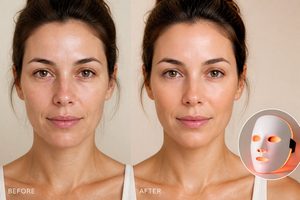
Read through real customer reviews of at-home LED light therapy and the before-and-after photos, then decide whether it fits the routine you already keep. Individual results may vary.
Frequently Asked Questions
Is Photobiomodulation the Same as Red Light Therapy?
Photobiomodulation is the scientific term, and red light therapy is the common name for the red-wavelength version of it. Photobiomodulation also covers near-infrared and blue light applications, so red light therapy is one category within it.
What Does Photobiomodulation Do for Facial Skin?
It signals skin cells to produce more energy, which supports collagen production, cellular turnover, and reduced inflammation. Those changes affect the appearance of fine lines, tone, texture, and oiliness over consistent use. Individual results may vary.
Is Photobiomodulation Legitimate for At-Home Skincare?
Yes, there is real published research behind it, including dermatology literature on red and blue LED light for skin. Harvard Health notes the American Academy of Dermatology considers many at-home LED devices safe, while also pointing out that optimal home doses are still being studied.
How Often Should I Use an LED Light Therapy Device?
Start with two sessions per week at 10 to 20 minutes each, then adjust based on how your skin responds and what your device’s instructions recommend. Research on cosmetic results points to several sessions weekly over four to six months before judging outcomes.
Is Photobiomodulation Approved by the FDA?
Some red light therapy devices are cleared by the Food and Drug Administration, or FDA, which means the agency reviewed them as safe for their stated use. Look for “FDA-cleared” on a device listing, and remember that cosmetic LED masks are intended for appearance, not to diagnose or treat any medical condition.