You moisturize your face every night. You apply serum, you pat in eye cream, and then you stop at the jawline. Months later, you catch your reflection in a car window and notice the horizontal lines across your throat look deeper than anything on your face. The neck is the most overlooked area in most anti-aging routines, and it shows.
That gap is exactly why so many women start researching red light therapy for neck wrinkles before they consider anything invasive. Light therapy devices using 620nm red light are marketed for collagen support, and licensed estheticians have been recommending at-home LED (light-emitting diode) tools for years. The science is real, but so are the limits.
What follows works through the neck in four parts: why it ages ahead of your face, what red light does in skin this thin, what months of use will and will not change, and how to run a session without wasting your time. You should finish able to read a device spec sheet and judge a before-and-after photo without being sold anything.
Why the Neck Often Shows Aging Before the Face
Neck skin is structurally different from facial skin, and that difference explains most of the early aging you see there. It is thinner, holds less oil, and moves constantly every time you turn your head or look down.
Add decades of skipped sunscreen and the gap widens fast. Many women who have used retinol and vitamin C on their face for years have applied almost nothing below the chin.
Thinner Skin, Fewer Oil Glands, and Faster Collagen Loss
The skin on your neck is noticeably thinner than the skin on your cheeks. Less thickness means less structural support from collagen and elastin, so lines settle in sooner and look sharper.
Oil glands are also sparser here. Fewer glands mean less natural lubrication, which leaves neck skin drier and more prone to that crepey, tissue-paper look.
Collagen loss compounds the problem, since production slows steadily after your mid-20s and thin skin has less reserve to spend before the change becomes visible.
How Sun Exposure and Daily Sunscreen Habits Affect the Neck and Décolleté
Sun damage drives most visible neck aging. The front and sides of the neck catch light through car windows, at outdoor lunches, and on every walk you take without a scarf.
The décolletage gets hit even harder because of open necklines. Sun damage there shows up as mottled brown patches, redness, and fine crisscross lines.
A few habits that protect this area:
- Apply broad-spectrum SPF 30 or higher to the neck and chest every morning, not just the face
- Extend sunscreen down to the collarbone and around to the back of the neck
- Reapply after sweating or swimming, since the neck rarely gets a second coat
- Use a scarf or high collar during long drives, when one side takes more exposure
How Tech Neck and Posture Create Horizontal Neck Lines
Every time you look down at a phone, the skin across the front of your neck folds. Repeat that thousands of times a week and the folds start to hold their shape.
These horizontal bands are often called tech neck lines. Posture plays a role too, since a forward head position keeps the skin compressed for hours at a time.
Raising your screen to eye level reduces how often the skin creases. It will not undo existing lines, but it slows the repetition that deepens them, and that makes it the only item on this page that costs nothing.
Crepey Texture, Dry Skin, and Changes in Skin Firmness
Crepey texture comes from a mix of moisture loss and thinning dermal support. The surface looks finely wrinkled even when the skin is at rest.
Dryness makes it worse. Dehydrated skin reflects light unevenly, so every small line becomes more visible under overhead lighting.
Firmness is the deeper issue, and it traces back to how much collagen and elastin your skin is building. That is where red light enters the picture.
How Red Light Therapy for Neck Wrinkles Works in the Dermis
Red light reaches the dermal layers of your skin and gives cells more energy to do repair work, including building collagen. Dermatologists call this process photobiomodulation, and it was previously known as low-level light therapy.
The effect is gradual and cumulative. Nothing happens in a single session, which is why devices are designed for repeated weekly use.
What 620nm Red Light Does in the Dermal Layers
Visible red light in the 620nm range penetrates past the surface and into the dermis, where collagen and elastin live. That depth is what separates it from a topical cream, which works mostly at the surface.
Once the light reaches those layers, skin cells absorb it and convert it into usable energy. The response is biological rather than thermal, so you feel no heat and need no recovery time.
Devices list their wavelength in nanometers for a reason. A 620nm red setting and a 460nm blue setting behave differently in the skin because they travel to different depths.
Where the Energy for Repair Comes From
Mitochondria are the energy factories inside your cells, and one enzyme in them, cytochrome c oxidase, absorbs red light particularly well.
Absorbing that light pushes the cell to make more adenosine triphosphate (ATP), which is what it spends on everything it does. Harvard Health’s overview of red light therapy for skin care describes this mitochondrial stimulation as the believed route to reduced inflammation and increased collagen production.
More fuel means cells can spend energy on repair and rebuilding. Stated plainly, that is the whole mechanism behind cosmetic 620nm red light sessions.
How Fibroblasts Support Collagen and Elastin Production
The cells doing the actual manufacturing are fibroblasts, and they sit in the dermis making collagen and elastin at a rate that falls off with age. That slowdown is a direct cause of sagging and lines.
Give fibroblasts more ATP, and they have more capacity to produce both proteins. Laboratory work has reported increased collagen expression in skin cells treated with red and infrared light.
Because neck skin is thin, changes in fibroblast activity can show up as firmer-looking texture over time. Individual results may vary.
Red Light, Microcirculation, and Inflammation in Aging Skin
Red light also supports microcirculation, the flow of blood through the tiny vessels feeding your skin. Better flow delivers more oxygen and nutrients to cells that are trying to rebuild.
At the same time, photobiomodulation is thought to calm low-grade inflammation and oxidative stress. Both wear collagen down over years without ever announcing themselves, so reducing them protects what you already have.
Less inflammation often reads on the skin as less redness and a more even tone.
Is Deeper Better? What the Near-Infrared Premium Buys
Near-infrared light sits above 800nm and penetrates deeper than visible red. It is used more often in clinical settings and for tissue repair goals.
For cosmetic neck concerns, visible red light in the 620nm range targets the dermal layers where collagen sits. A controlled trial of red and near-infrared light for skin rejuvenation measured improvements in fine lines, skin roughness and intradermal collagen density, and found that a broader polychromatic spectrum held no advantage over red alone.*
That finding is worth carrying into a shop window. A well-designed red setting does the job, so a premium charged for deep near-infrared claims is not automatically buying you more.
* Individual results may vary. Findings reference external clinical studies, not PlushDerm-specific trials.
What Months of Use Will and Will Not Change
Expect softer-looking fine lines, smoother texture, and more even tone over several months of consistent use. Expect no change to deep folds, loose skin, or vertical muscle bands.
Red light works on the quality of the skin, not on its underlying structure. Setting that boundary early saves you from disappointment at week four.
Fine Lines, Crepey Texture, and Skin Tone Changes
The changes most users notice first are surface-level. Skin looks less dull, and the crepey areas reflect light more evenly.
Fine lines soften before deeper ones do. Horizontal neck lines that only appear when you tilt your head respond better than lines etched in at rest.
Tone improvements show up as reduced redness and slightly more uniform color. The American Academy of Dermatology’s guidance on red light therapy for skin is worth reading alongside any product page, and one caution belongs here: melasma has its own triggers and needs its own plan, so do not expect a light device to be the answer to it.
What the Clinical Studies Actually Measured
This is where product pages tend to overreach, so it is worth being exact. The trials that support red light for aging skin measure things like wrinkle depth, skin roughness, and dermal density read by ultrasound. Dermal density is a measure of tissue structure, not a count of collagen your body produced, and an article that converts one into the other has changed the finding without telling you.
Those studies also test particular devices at particular doses on particular schedules. The distinction that matters when you are shopping is not that consumer masks go untested. It is that whichever device you are about to buy almost certainly was not the one in the study.
Summaries of the research are collected in this overview of LED study findings, which is a reasonable place to see how the trials are structured before you weigh any marketing claim against them.
Why Red Light Cannot Erase Deep Neck Folds or Muscle Bands
Deep horizontal folds involve skin that has creased in the same place for years. Light therapy improves the surrounding tissue quality, but the fold itself stays.
Vertical bands down the front of the neck come from the platysma muscle, not the skin. No wavelength of light changes muscle position.
Significant laxity, where skin hangs loose under the jaw, is also outside what LED therapy addresses. Those concerns belong in a conversation with a board-certified dermatologist.
Before-and-After Photos: How to Assess Changes Fairly
Photos lie easily. Lighting angle, chin position, and camera distance can create or erase a neck line without any change to your skin.
To judge fairly, look for:
- Identical lighting and background in both shots
- The same head and chin angle, ideally neutral and level
- No makeup or body glow in either photo
- A stated time gap, such as 12 weeks, rather than a vague “after”
- Skin at rest, not stretched or tilted
The accounts people post after months of use tend to describe gradual change rather than a reveal. Apply the same scrutiny to any photo set you see, including the ones you take yourself.
Running a Session on a Curved Surface
The neck is the part people get wrong, because a flat device and a curved throat do not meet evenly. Everything below is about closing that gap.
Why Fit Decides How Much Light Your Neck Receives
The throat curves in two directions at once. A panel held at arm’s length lights the front of the neck reasonably, and the sides barely at all, and the sides are where these lines tend to run.
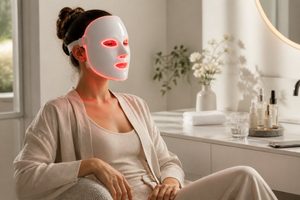
A flexible device resting against the skin removes the distance problem entirely. Sit it close without pressing, and check that it reaches around to the sides and down toward the collarbone instead of stopping at the front of the throat. The manufacturer publishes setup and placement steps for its face and neck devices.
Bare skin matters here for the same reason it does above the jaw: whatever sits on top of the skin is in the light’s way. Cleanse, dry, treat, then layer products afterward. That order exists to keep the path clear beforehand, not because skin turns more receptive afterward, which is a claim you will meet on product pages and which sequencing alone does not establish.
How Often, and Why More Is Not the Lever
Two sessions a week at 10 to 20 minutes is the published starting point, and each cycle runs 10 minutes before cutting out, so a longer sitting means a second cycle rather than a stretched first one.
Whether to go past two is not a question the research settles, and not one this article will answer for you. Take it from your own device’s documentation. Harvard Health is clear about the part that does decide the outcome: several sessions a week sustained over four to six months before an at-home device is worth judging at all.
Stretching a session is not a shortcut. Even coverage, repeated for months, is the variable you actually hold.
Where Red Light Fits With Retinol, Retinoids, Vitamin C, and Peptide Serum
Treat on bare skin, then apply your actives. Neck skin turns sensitive to retinoids faster than facial skin does, because there is less of it, so the spacing below matters more here than it would on your cheeks.
A practical weekly rhythm:
- LED nights: cleanse, treat with red light, then apply a peptide serum and moisturizer
- Retinoid nights: skip the mask, or run the session first and apply retinol 20 minutes later
- Mornings: vitamin C serum, moisturizer, broad-spectrum SPF, no LED needed
- If irritation appears: stop the light sessions as well as the retinoid until the skin settles, then reintroduce one at a time
That last line matters more than it looks. Advice to pause your topicals and carry on with the light is common, and it is wrong. An adverse reaction is a reason to stop the device too, and PlushDerm’s own terms say to discontinue use immediately. Once the skin is calm, bringing one thing back at a time is the only way to learn which one caused it.
Treating the Neck and Décolleté in the Same Session
Extend the device or reposition it to cover the upper chest, since the décolletage takes sun damage in the same patterns and responds to the same wavelength.
Some systems handle this by pairing a face device with a separate neck device you run at the same time. The paired face and neck devices come with two rechargeable batteries at $350 all-in, and because each runs off its own battery pack by cable rather than off the wall, a session does not have to happen within reach of a socket.
Covering both zones the same evening keeps the tone consistent from jawline to chest. Which raises a fair question: how do you tell a well-made neck device from a poorly made one?
How to Choose a Neck Device and Use It Safely
Look for full coverage of the treatment area, a stated wavelength, a fit that follows the neck’s curve, and clear safety instructions. Then check whether the device is FDA-cleared and what that label covers.
Safety issues with LED therapy are limited, but a few conditions call for a professional opinion first.
Coverage, Fit, and Portable Design for the Neck Area
The neck curves in two directions at once, so rigid panels leave gaps. Flexible silicone designs conform to the throat and the sides where lines form.
How a device is powered changes how often you use it. A unit running on its own battery pack can be used on the couch or in a hotel room, while anything that has to reach a wall socket keeps you within a cord’s length of one for the whole cycle.
Coverage area is the other spec worth reading closely, because a device sold for the face may stop at the jawline and leave the exact area you bought it for untreated.
Red and Blue Light Modes for Aging Concerns and Breakouts
Red at 620nm targets collagen and texture. Blue at 460nm targets acne-causing bacteria, and it is the setting to reach for when the neck or jawline breaks out.
Some devices offer both plus a mixed mode. That third option suits anyone dealing with early lines and active breakouts at once, and a setting that runs both wavelengths at once exists for exactly that. Look into what 460nm blue light is for before choosing it as your default, because it serves a different goal than red.
Neck acne often comes from hair products and collars, so adjust those habits alongside any light setting.
Reading the FDA-Cleared Label Correctly
FDA-cleared means the Food and Drug Administration reviewed the device and found it substantially equivalent to a legally marketed product. It signals a safety review, not proof of results for your specific concern.
Clearance also says nothing about how strong the LEDs are or how long you should use them. Harvard Health’s guidance makes the same point from the other direction, noting that the optimal dose per session has not been pinned down.
Treat the label as a baseline check, then evaluate wavelength, coverage, and session design separately.
Who Should Get a Professional Opinion First
Keep light out of your eyes and use whatever shields your device’s instructions call for, rather than assuming a set was included. For neck-only sessions, this is easier, since the device sits below your chin.
Any of the following is worth a conversation before you begin:
- Take photosensitizing medications, including certain antibiotics
- Have lupus or another light-sensitive condition
- Are pregnant
- Have a history of skin cancer or precancerous lesions
- Have very sensitive skin or an active skin condition on the neck
- Have a deeper skin tone, since visible light can trigger dark spots at higher doses
Stop use if you notice a reaction beyond mild, brief redness.
Why LED Therapy Does Not Replace Dermatology Care or Clinical Procedures
At-home LED devices are cosmetic tools, sold to change how skin looks. None of them is a medical device, and none should be used as a stand-in for one.
Microneedling, microcurrent, injectables, and laser resurfacing work through entirely different mechanisms and reach depths a home device does not. A new or changing mole, persistent rash, or sudden skin change needs a dermatologist, not a mask.
Where LED therapy fits is the maintenance layer between appointments, or as a first non-invasive step for someone not ready for procedures.
Give the Neck What You Already Give the Face
The neck responds to the same care your face gets, and red light at 620nm supports the collagen and elastin that keep skin looking firm. Thin skin, sun exposure, and daily phone posture explain why it ages faster. Sunscreen, hydration, and two LED sessions a week address all three.
Give it four to six months before judging. Take honest photos in the same light, keep retinol on separate nights, and treat the neck and décolleté in the same session so the results match from jawline to chest. Individual results may vary.
The practical question is whether a device reaches the area you are actually worried about, which rules out a good deal of what is sold for the face. PlushDerm covers the neck with a device of its own rather than an extension of the mask, at $350 for both, and plants five trees per order. Have a look at the full set when you are ready to decide.
Frequently Asked Questions
Will Red Light Therapy Make a Difference to My Neck Lines?
Red light therapy supports collagen and elastin production in the dermis, which can soften the look of fine neck lines over months of consistent use. Published trials report reduced wrinkle depth and increased dermal density measured by ultrasound, which is a measure of tissue structure rather than a count of collagen produced.* It works best on fine lines and texture, not on deep folds. Individual results may vary.
Can Red Light Therapy Help Crepey Neck Skin?
It can improve the appearance of crepey texture by supporting collagen production and reducing inflammation in thin neck skin. Pairing sessions with daily moisturizer and sunscreen makes a bigger difference than light alone, since dryness exaggerates crepiness. Individual results may vary.
Will My Neck Catch Up to My Face if I Start Now?
Not entirely, and it helps to know that going in. Your neck is carrying years of sun exposure your face did not take, on skin that had less structure to begin with, so the gap you are seeing has a head start on any device. What consistent use can do is slow the divergence and improve the texture and tone of the skin that is there. Judge it against where your neck would have been, not against your face.
Can Red Light Do Anything About Tech Neck Lines?
Partly. Horizontal lines from looking down are made by repeated folding, so the fold itself keeps being remade every time you drop your chin to a screen. Red light works on the quality of the skin doing the folding, which is why these lines respond better when they are still shallow and appear mainly on movement. Raising your screen to eye level does more for the cause than any device does.
What Can Go Wrong on Skin This Thin?
Not much, and what does is usually brief redness that fades within the hour. The real cautions are about who should not start without asking: anyone on photosensitizing medication, anyone with a light-sensitive condition, anyone with a history of skin cancer, and anyone with a deeper skin tone, since visible light can provoke dark spots at higher doses. If a reaction does appear, stop the device rather than adjusting everything else in your routine around it.