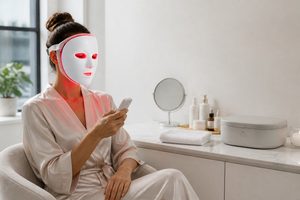
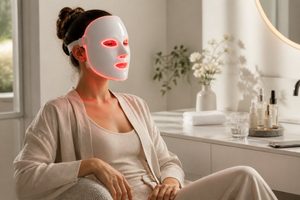
You notice them in bright bathroom light or in a photo from last weekend. The fan of fine lines at the outer corner of each eye is holding its shape a beat longer than it once did. With consistent use over weeks, red light therapy for crow’s feet can support softer, less noticeable lines by encouraging collagen and elastin activity in the skin around the eyes. Individual results may vary.
The skin around the eyes is the thinnest on your face. It folds thousands of times a day and holds less collagen to bounce back with. That is why eye wrinkles show up before lines anywhere else, and why the right wavelength matters when you choose an at-home device.
Three things are worth getting straight before you buy anything: what the research on eye-area wrinkles actually measured, how 620nm red light works on the layer underneath the crease, and where the safety line sits when a light source is that close to your eyes. The last one is the part most articles skip.
Can LED Light Soften the Look of Eye Wrinkles?
Yes, published studies show measurable improvement in periocular wrinkles after repeated red LED (light-emitting diode) sessions. The changes are gradual and modest, and they depend on sticking with a schedule.
Photobiomodulation is the medical term for this kind of light therapy. It uses red light in the 620 to 700 nanometer range and near-infrared light above 700 nanometers, and dermatology reviews classify it as a noninvasive phototherapy used for skin rejuvenation.
What Current Research Suggests About Periocular Wrinkle Reduction
One controlled trial compared 660nm red LED panels against a broad-spectrum white LED group. Researchers reported that low-level light therapy significantly improved periocular wrinkles, with the red group scoring higher on global assessment.*
That study is the most directly relevant evidence there is for this question, and it is worth being clear about what it does not settle. It ran at 660nm, not 620nm. It used a research panel, not a mask you can buy. And a single trial with a positive result is a starting point rather than a finished case.
Newer work has moved toward measuring wrinkle volume with imaging rather than scoring photographs by eye, which matters here because subtle change at the outer corner is almost impossible to judge from memory.
* Individual results may vary. Findings reference external clinical studies, not PlushDerm-specific trials.
Where the Evidence Stops
Red light supports the skin’s own repair pathways. It does not relax muscle or fill volume loss under the skin.
Here is a fair split:
- Reasonable to expect: softer surface texture, less visible fine lines, a smoother look around the eye contour
- Not what it does: limit muscle movement, replace lost fat pads, tighten loose eyelid skin, or treat any eye condition
- Works best alongside: daily sunscreen, sunglasses, and a gentle eye cream
Light therapy is a cosmetic tool. It is not a substitute for care from a dermatologist or another healthcare professional, and nothing here should be read as a reason to postpone one.
The Line That Only Shows When You Smile
Some of what you see at the corner of your eye is a crease your muscles are making in that moment. The rest is a crease that has stopped needing them.
Botulinum toxin injections target the dynamic kind by limiting muscle movement. Red light works on a different problem entirely: the quality and density of the dermis underneath those creases.
That means red light has the most influence on early static lines and crepey texture. Squint into a mirror, then let your face go slack. What is still there at rest is what an at-home device is aimed at.
Why Crow’s Feet Show Up Early
Eye-area skin is the thinnest on the face and has fewer oil glands protecting it. Combine that with constant movement and sun exposure, and the outer corners crease first.
How Repeated Smiling, Squinting, and Blinking Create Creases
The orbicularis oculi muscle circles your eye like a ring. Every blink, smile, and squint pulls the overlying skin into the same fan pattern.
You blink around 15 to 20 times a minute. Over decades, that folding trains the skin to hold the crease even at rest.
Young skin springs back because its collagen and elastin network is dense and elastic. As that network thins, the fold sets.
How UV Exposure Speeds Up Photoaging
Ultraviolet (UV) light breaks down dermal collagen and damages elastin fibers faster than your body rebuilds them. Dermatologists call the result photoaging, and the eye area takes a heavy share of it.
Squinting in bright sun adds mechanical folding on top of the UV damage. Sunglasses and a broad-spectrum sunscreen around the orbital bone reduce both problems at once, which is why sunglasses sit on the list above next to the device.
Harvard Health notes that light therapy complements strict sun protection without replacing it. Running a device while skipping sunscreen means spending months supporting collagen that UV is dismantling in the background.
Why Thin Eye-Area Skin Loses Support Over Time
Collagen density in the dermis drops steadily from your late twenties onward, and less collagen means less structural support under the surface.
Elastin loss compounds it. Skin elasticity fades, so creases that once smoothed out in seconds linger.
Surface texture changes too, growing finer and more crepey. That thinning layer is exactly what red light aims at, which is why the wavelength on the box is worth reading.
How Red Light Therapy for Crow’s Feet Works Under the Skin
Firmer, smoother-looking skin comes from healthier fibroblast activity in the dermis. Red light gives those cells more energy to do that job.
The Wavelength That Reaches the Layer That Matters
Wavelengths between 620 and 660nm are long enough to pass the surface layers and land in the part of the dermis where new collagen and elastin get built. In cell-model work, red light increases collagen expression at those wavelengths.*
PlushDerm’s 620nm light therapy mode sits inside that studied band. Its setting for blue light for oil and breakouts runs at 460nm and does nothing for eye wrinkles, so if crow’s feet are the reason you are shopping, the red figure is the one to check. A dual-wavelength mode exists for people managing aging and breakouts at once.
The Role of Mitochondria, ATP Production, and Fibroblasts
Inside your cells, mitochondria produce energy as ATP (adenosine triphosphate). Red light is picked up by an enzyme in the mitochondrial chain, cytochrome c oxidase, and the result is more ATP per cell.
More ATP means fibroblasts can build collagen and elastin more efficiently. Red light also supports microcirculation, delivering more oxygen and nutrients to the eye contour.
None of that happens in a session or a week. Collagen remodeling is a slow rebuilding process, which is the single most important thing to understand before you judge whether a device is working.
Why Near-Infrared Light Research Should Be Separated From Red-Light-Only Claims
At 850nm you are past the visible range and into light that travels further through tissue. Plenty of published trials run red and near-infrared together, and a result from a trial like that belongs to the pair, not to the red half.
Keep the distinction clear when you compare devices:
- Red light (620 to 700nm): the part you can see, stopping in the upper dermis, and the band with the wrinkle research behind it
- Near-infrared (700 to 1440nm): invisible, penetrates deeper, studied for tissue repair and pain
- Combination studies: results reflect both wavelengths together, not one in isolation
A device that lists 620nm red should be judged against red-light research, not against a trial that also ran near-infrared. How you use it near your eyes is the next thing to get right.
How to Use At-Home LED Therapy Around the Eye Area Safely
Never place an LED mask or panel directly on or over your open eyes. Treat the skin around the orbital bone, and follow the eye-area instructions that came with your specific device.
Keep the Device Away From the Eyes and Follow Its Eye-Area Instructions
Manufacturer directions exist because irradiance, fit, and eye-area coverage differ between products. PlushDerm’s eye-area positioning instructions cover setup and placement before a first session, and its published guidance recommends starting with two sessions per week of 10 to 20 minutes, with each treatment cycle running 10 minutes before it shuts off.
That schedule is what the manufacturer publishes. It is not a ladder you are meant to climb, and no reputable source can tell you how far to escalate, so take any escalation advice from your own device’s documentation rather than from an article.
Stop use if you notice stinging, lasting redness, or any other adverse reaction, and do not resume until you have worked out what caused it.
Protection Rules Are Set by the Device, Not by the Category
This is the one instruction not to improvise around, because what counts as adequate protection is set per product rather than across the category. Read your own directions, use the shields or goggles they specify, and do not assume a set came in the box because a friend’s device included one. Shut eyelids are thin and translucent; they are not the protection a manufacturer means when it specifies protection.
A mask that shifts or gaps also lets light angle where you did not intend it, which is a fit problem rather than a wavelength problem.
Practical checks before you start:
- Wash and dry skin so no product blocks the light
- Confirm the device sits flat against your cheekbones and temples
- Use whatever eye protection your device’s instructions call for
- Keep sessions to the timed cycle instead of stacking back-to-back rounds
Reasons to Clear It With a Doctor First
Past eye surgery, an active eye disease, or a diagnosed light-sensitive condition such as lupus all warrant a conversation before your first session. So does any medication that raises photosensitivity, a category that includes several common antibiotics.
Retinoids deserve their own mention. A topical retinoid or retinol thins the stratum corneum temporarily, so apply it at a different time from your session and watch the eye area for irritation.
Pregnancy, sensitive skin, an existing skin condition, or a history of skin cancer are all reasons to ask before you begin.
How Long Until the Corners Look Different?
Most published protocols measure change at 8 to 12 weeks of regular sessions. Expect gradual softening of fine lines and smoother skin texture, not a dramatic reset.
Why Collagen-Related Changes Take Time to Show
New collagen forms and organizes slowly. Fibroblasts need repeated stimulation across many weeks before the dermis measurably changes.
Writing for Harvard Health, dermatologist Dr. Rachel Reynolds sets the bar higher still: several sessions a week over four to six months before an at-home device can fairly be judged. Very few product pages will tell you that, which is reason enough to hear it here.
It also explains why people who quit after three weeks report nothing. The variable that moves the outcome is how many months you keep going, and individual results still vary.
How to Catch a Change This Small
Photograph the same eye area in the same light, at the same time of day, once every two weeks. Use a neutral expression and no makeup.
Watch for these markers instead of relying on memory:
- Whether static lines look shallower when your face is at rest
- How quickly a smile crease smooths out afterward
- Whether eye cream sits more evenly across the skin
- Overall crepiness at the outer corner in side lighting
Write a one-line note after each session. A simple log tells you whether you actually hit two sessions a week or slid down to one without noticing, which is usually the real explanation when nothing seems to be happening.
How Sunscreen, Retinoids, and Hydration Support Your Routine
Broad-spectrum sunscreen every morning protects the collagen you are working to support. A pea-sized amount of retinol a few nights a week accelerates cell turnover through a separate pathway, and pairing it with a hydrating eye cream limits the dryness that puts people off it.
Sleep, water, and a gentle cleanser round out the routine. Where those habits end, the device you choose starts to matter.
Small Lines Answer to Small Habits
Softer crow’s feet come from repetition rather than intensity. Two evenings a week for several months does more for the skin at your outer corners than any single session can, which makes the practical question whether a device fits your evenings at all.
Red light at 620nm supports collagen activity in the dermis beneath those lines. Blue light at 460nm handles oil and acne-causing bacteria if breakouts are part of your picture. A mask offering both gives you one tool for two concerns, and the neck deserves the same attention as the face, since it creases just as visibly and gets treated half as often.
PlushDerm’s face and neck package includes separate face and neck devices, two rechargeable batteries that free you from sitting near an outlet, and three light settings for $350 all-in, with five trees planted for every order. Read what long-term users report, then see what is in the box and start where you are. Individual results may vary.
Frequently Asked Questions
Is Red Light Therapy Good for Crow’s Feet?
Yes. A controlled trial of red LED light reported significant improvement in periocular wrinkles after several weeks of regular sessions.* It works on the skin around the eyes by supporting collagen and elastin, so the lines look softer over time rather than disappearing. Individual results may vary.
Will It Do Anything for a Deep Crease at the Corner?
Less than you would want. A deep crease at the outer corner usually involves three things at once: repeated muscle movement, thinning skin, and lost volume in the surrounding fat pads. Red light addresses only the middle one. Expect it to improve the texture and fine lines around a deep crease without changing the crease itself, and talk with a dermatologist about clinical options if the fold is the thing bothering you.
Do Eye Wrinkles Respond Faster or Slower Than the Rest of the Face?
Nobody has measured that comparison directly, so anyone giving you a confident answer is guessing. What is known cuts both ways: eye-area skin is thin, so light reaches the working layer easily, and it is also the area under the most constant mechanical folding of anywhere on your face. Judge it on the same 8 to 12 week horizon you would use anywhere else.
Is It Safe to Use an LED Mask Near the Eyes?
Only within the boundaries your device sets. Keep the light off your open eyes, treat the skin over the orbital bone rather than the lid, and use whatever eye protection the instructions specify, since requirements differ by product and shields are not always included. Shut eyelids do not stand in for shields that a manufacturer has specified. Check with a doctor first if you have an eye condition or take photosensitizing medication.
Can I Use a Full-Face Mask if Crow’s Feet Are My Only Concern?
Yes, and it is usually the more sensible buy. A full-face device treats the outer corners along with the rest of the face for the same ten minutes, whereas a device sold specifically for the eye area treats a small zone for the same effort. What matters more than coverage is whether the mask sits flat against your cheekbones and temples, because a gap there is exactly where light stops reaching the lines you bought it for.