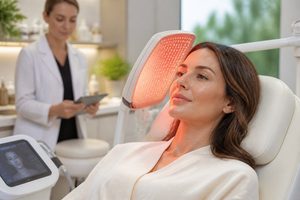
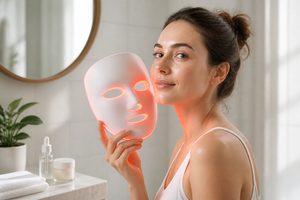
You bought the mask, or you are close to buying one, and you want to know what your skin will look like in a month. Maybe you noticed crow’s feet in a sunlit selfie. Maybe a breakout keeps returning along your jawline. Either way, you want proof before you commit ten minutes a few nights a week.
Here is the honest frame for LED face mask before and after expectations: changes from light emitting diode (LED) therapy build slowly and stack over weeks, and individual results vary. Nothing shifts overnight. What shifts is skin that gets repeated, consistent exposure to the right wavelengths over two to three months.
Ahead are the changes that tend to show up in the first two weeks, the ones that usually take six to twelve, and how red light at 620nm and blue light at 460nm produce different outcomes. You will also leave knowing how to photograph your own progress so your comparison photos tell you something true.
What Changes Can You Realistically See, and When?
Most people notice surface changes first, such as a temporary glow and better-hydrated skin, while texture and firmness take a month or more. Clinical reviews describe improvements in skin texture and wrinkles as subtle and gradual after regular use. Individual results may vary.
That timeline exists because light works on different processes at different speeds. Circulation and hydration respond quickly. Collagen remodeling in the dermis is slow biology that measures its progress in months.
Days 1 to 14: Early Glow, Hydration, and Calmer-Looking Skin
In the first two weeks, some users notice a short-lived flush of radiance right after a session and skin that feels less tight. Increased blood flow to treated areas explains most of it. That effect fades within hours at first.
Skin may also look calmer. Red light is associated with reduced inflammation, so areas that look irritated can appear less angry. Do not expect fine lines to change yet.
Track your sessions during this period instead of your face. Two sessions per week at 10 to 20 minutes is the published starting point for these devices, with each cycle running 10 minutes before shutting off automatically.
Weeks 3 to 6: Smoother Skin Texture and More Even Skin Tone
Around week three to six, texture is the first real change many people see. Skin feels smoother to the touch and reflects light more evenly, which reads as better skin tone in photos.
This stage reflects cellular turnover picking up. Fresh surface cells scatter light differently, so roughness softens. Makeup tends to sit better, which is often the first thing a friend comments on.
Blue light users on a mixed setting may see fewer new blemishes by this point. Existing marks stay put. Pigment fades on its own schedule.
Weeks 8 to 12: Fine Lines, Firmness, and Cumulative Change
Fine lines and firmness are the slowest markers to move, and week eight is the earliest most studies measure meaningful change. Collagen and elastin production ramp up over weeks, then the dermis reorganizes that new material.
One frequently cited trial measured a 47.7% increase in ultrasound-measured dermal density after 84 days of red light use at 630 ± 10nm.* That study tested its own professional-grade mask, not PlushDerm, and dermal density is not a direct measure of collagen production.
* Individual results may vary. Findings reference external clinical studies, not PlushDerm-specific trials.
What this stage looks like in practice:
- Fine lines around the eyes appear softer in neutral light
- Skin feels more elastic when you press and release
- Deeper folds change least, if at all
- Neck skin often lags behind facial skin
After Three Months: What Happens If You Stop
Gains are maintained rather than banked. Dermatology commentary on red light therapy in cosmetic dermatology notes that benefits are incremental and temporary without continued use.
What that does not tell you is the shape of the decline: nobody has published a schedule for how quickly results fade, or how long a break costs you. Anyone offering you a specific number there, including how many weeks off undo how many months of work, is inventing it. What is established is the direction, which is that the effect depends on the routine continuing. How often you continue is a question for your device’s instructions.
This is where device design starts to matter, because the areas you cover and the sessions you actually run are the two inputs you control. What happens during those ten minutes depends entirely on which wavelength you select.
How Red Light May Support Smoother, Firmer-Looking Skin
Red light supports smoother, firmer-looking skin by reaching fibroblasts in the dermis and nudging them to produce more collagen and elastin. Photobiomodulation, the term for this process, uses light in the 620 to 700 nanometer range to trigger cell activity without heat damage.
Why 620nm Red Light Is Used for Fine Lines and Wrinkles
620nm sits at the shorter end of the therapeutic red band, deep enough to reach the upper dermis where collagen lives. Shorter visible wavelengths stop in the epidermis. Longer near-infrared light passes deeper into tissue.
At-home masks that offer a 620nm red setting commonly use 620nm to 660nm. The mechanism is the same across that band. Penetration depth and dose differ.
Ten minutes per cycle is the standard treatment window for consumer devices at this wavelength.
Photobiomodulation, Fibroblasts, and Collagen Synthesis
Light gets absorbed by cytochrome c oxidase inside mitochondria, the energy centers of your cells. That absorption raises cellular energy output. Fibroblasts use that energy to build collagen and elastin.
A photobiomodulation review in dermatology describes this as light in the red (620 to 700 nm) and near-infrared spectrum delivered through low-level lasers or LEDs. In the lab, pairing low-level red with near-infrared has lifted production of both collagen and elastin in photo-aged skin.
What Clinical Studies Can and Cannot Tell You About Collagen Density
Studies confirm fibroblast stimulation. They cannot promise you a specific number of millimeters off a wrinkle.
Three limits worth knowing before you read any statistic:
- Different devices. Published trials test particular devices, usually professional or research panels. The distinction that matters is not that they avoided testing consumer masks; it is that none of them tested the mask you are buying.
- Different measurements. Ultrasound dermal density, biopsy collagen counts, and rater-scored photographs measure different things, and a percentage from one cannot be read against a percentage from another.
- Short study windows. Long-term data on at-home use is thin.
At-home devices have shown less effect than in-office treatments in comparative discussions. That gap comes down to power output and session supervision.
Which Lines May Look Softer First: Crow’s Feet, Forehead Lines, and Expression Lines
Shallow lines respond first. Crow’s feet, the fine lines fanning from the outer corners of the eyes, sit in thin skin with less structural depth, so small collagen gains show sooner there.
Forehead lines and nasolabial folds are anchored by repeated muscle movement and volume loss. Light does not address either one. Expect softening at the edges of those lines, not erasure.
Never place an LED device directly on or over your eyes, and follow the included instructions for the eye area every session. Red light handles one half of the equation. The 460nm setting works on a completely different target.
How Blue Light Results Differ for Acne, Oiliness, and Pores
Blue light targets acne-causing bacteria, which means the before-and-after story is about fewer new breakouts, not smoother wrinkles. Results show up faster than red light results and follow a different pattern entirely.
Why 460nm Blue Light Targets Acne-Causing Bacteria
Cutibacterium acnes, formerly called P. acnes, produces porphyrins. Those compounds take in blue wavelengths and set off an oxidative reaction that breaks the bacterium down from inside. That is the whole mechanism.
460nm sits in the effective absorption range. Blue light settings on consumer masks typically fall between 415nm and 465nm for this reason.
Blue light penetrates far less deeply than red. It stays in the epidermis, which is exactly where follicular bacteria sit. A systematic review on the effect of blue light on acne vulgaris reported significant improvements in the overall picture of acne while calling for more detailed trials.
What to Expect With Active Acne and New Breakouts
Expect fewer new inflammatory lesions over four to eight weeks of consistent use. Existing deep cysts are not blue light’s strength.
You will sometimes see lesion-reduction percentages presented as a ranking between colors: figures around 60.9% for blue light, 43% for red, and 19.9% for combined blue and red have circulated in this form.* Read those with care. They come from separate studies with different participants, protocols, doses, and scoring methods, so lining them up produces a comparison nobody actually ran. The ordering is also worth noticing on its own terms: combination therapy scoring lowest of the three sits against the broader body of research, where pairing the wavelengths generally performs at least as well as blue alone. That is a strong signal you are looking at study design rather than wavelength performance.
* Individual results may vary. Findings reference external clinical studies, not PlushDerm-specific trials.
Home-based device evidence for blue and combination blue-red LED has been graded as moderate quality with favorable safety profiles, which is a more useful summary than any single percentage.
Oiliness and pore appearance may shift as inflammation settles. Pore size itself is structural and does not change.
Redness, Post-Acne Marks, and Concerns That Need a Different Approach
Post-acne redness and dark spots fade on their own timeline and respond more to sun protection and topical actives than to blue light. Acne scars with texture, meaning pitted or raised scars, need resurfacing procedures.
Concerns light therapy does not resolve:
- Ice pick and boxcar acne scars
- Established hyperpigmentation and melasma
- Hormonal cystic acne requiring prescription care
- Deep static wrinkles from volume loss
A setting that runs 620nm and 460nm together suits skin dealing with aging and breakouts at once. Which brings up the harder question: how do you tell whether anything changed at all?
How to Take Honest Progress Photos and Get More From Your Routine
Comparable photos require fixed lighting, a fixed camera distance, and a neutral face. Change one variable and your before-and-after comparison stops meaning anything.
How to Take Comparable Before and After Photos
Shoot in the same spot at the same time of day. Morning light near a north-facing window works well because it stays consistent.
Your photo checklist:
- Same room, same light source, no direct overhead lighting
- Bare skin, no makeup, no moisturizer applied within the hour
- Hair pulled fully back
- Front, left profile, and right profile every time
- Same distance, ideally with your phone on a small tripod
- Relaxed face with no smile, no squint, no raised brows
Shoot day zero, then every two weeks. Monthly is too sparse to catch gradual change.
Why Lighting, Makeup, Sleep, and Facial Expression Can Mislead
Harsh side lighting deepens every line on your face. Soft front lighting erases them. Most dramatic online comparisons are lighting changes, not costume changes.
Sleep affects skin appearance within a single night. Photograph after a normal night’s rest, never after four hours of sleep or a salty dinner.
A slight smile lifts the mid-face and softens nasolabial folds. Keep your expression neutral and your chin level in every frame.
Where LED Therapy Fits With Vitamin C, Retinol, Peptides, and SPF
LED light layers cleanly with topicals because it adds no acid, no fragrance, and no barrier disruption. Use it on clean, dry, bare skin, then apply serums afterward.
A practical order:
- Morning: cleanse, vitamin C serum, moisturizer, SPF 30 or higher
- Evening: cleanse, 10 to 20 minute LED session, peptides or retinol, moisturizer
Sun protection does more for wrinkle prevention than any device. Sun damage and smoking both accelerate collagen breakdown faster than light therapy builds it.
Retinol and LED can be used the same night. Introduce them one at a time so you know which one causes any irritation.
Consistency, Irradiance, and Other Factors That Shape Results
Total light dose drives outcomes, and dose equals irradiance multiplied by time multiplied by frequency. A weaker device used four times a week can deliver more cumulative energy than a stronger one used twice a month.
Age, baseline skin condition, and how much of the face gets covered all affect what you see. A mask that covers the full face delivers more even dosing than a handheld wand.
Set-and-forget design helps. Following the positioning and timing instructions removes guesswork, and an auto shutoff at 10 minutes means you are not watching a clock. Not everyone should start a routine like this without checking first.
Who Should Use Extra Caution With LED Light Therapy?
Anyone with photosensitivity, an active skin condition, or a history of skin cancer should talk to a healthcare professional before starting LED therapy. Dermatologists describe LED masks as generally safe while noting that people sensitive to light should avoid them.
Sensitive Skin, Rosacea, and Existing Skin Conditions
Sensitive skin can react to any new stimulus, including light. Begin cautiously and watch closely rather than following a frequency plan from an article, and let your device’s documentation set the schedule.
Rosacea is complicated. Red light is studied for reducing inflammation, but flushing-prone skin sometimes reacts to heat or light exposure. Get a dermatologist’s read before you start.
Stop use at the first sign of an adverse reaction such as stinging, lasting redness, or new irritation, and let skin settle before going back.
Photosensitizing Medications, Pregnancy, and When to Ask a Healthcare Professional
Photosensitizing medications amplify skin’s response to light and make reactions more likely. Common categories include certain antibiotics, isotretinoin, and some blood pressure drugs.
Check with a healthcare professional before use if you:
- Take any photosensitizing medication
- Are pregnant or nursing
- Have an existing skin condition or very sensitive skin
- Have a history of skin cancer
- Have a seizure disorder triggered by flashing light
Eye protection deserves attention too, especially with blue light. Requirements differ between products, so follow the instructions that came with yours rather than a general rule.
Why an LED Mask Is Not a Replacement for Dermatology Care
At-home LED masks are cosmetic devices, built to change how skin looks rather than to treat anything.
Scarring acne, suspicious moles, and sudden skin changes need a dermatologist, not a mask. Prescription retinoids, in-office lasers, and injectables operate at intensities no consumer device reaches.
Treat light therapy as maintenance that supports your skin between professional care. That framing also makes your own progress easier to judge fairly.
Consistent Face and Neck Care Makes Results Easier to Evaluate
Treating the face and neck in the same session gives you a fair comparison, because skipping the neck leaves you evaluating two areas on different schedules. Neck skin is thinner, gets less product, and shows crepiness and horizontal lines earlier than most people expect.
Red light masks address collagen production in the same way wherever you apply them. The difference is exposure time. A device with separate face and neck coverage means both areas get the same 620nm dose on the same nights.
That matters for your photos. When you track skin texture, skin tone, fine lines, and acne across a single consistent routine, the variable you are testing is the light itself.
Many light therapy systems sell face and neck units separately: Omnilux, for instance, lists its Contour Face mask and its Contour Neck and Décolleté wrap at $395 each before discounts. A single package containing both devices, two rechargeable batteries, and a 10-minute auto shutoff changes the arithmetic and puts both areas in the same session.
Two sessions a week, both areas, twelve weeks, same photo setup. That is the experiment worth running.
What Your Twelve-Week Photos Will Actually Tell You
Give the routine three months before you judge it. Early weeks bring radiance and hydration, weeks three to six bring smoother texture, and weeks eight to twelve are where fine lines and firmness start to register. Individual results may vary, and the effect holds as long as the routine does.
The experiment only works if both areas are in the frame. PlushDerm’s face and neck pairing runs 620nm red, 460nm blue, or both together across both, ships with two rechargeable batteries that connect by cable, and costs $350 for the complete set. Licensed estheticians recommend it, five trees are planted with every order, and the study summaries behind red and blue light are published openly so you can read them against everything above.
Take your day zero photos tonight and start counting from there. The full product details are there when you want them.
Frequently Asked Questions
How Long Does It Take to See Results From an LED Face Mask?
Most people notice texture changes around weeks three to six and fine line softening around weeks eight to twelve. Radiance and hydration can appear within the first two weeks. Individual results may vary, and consistency matters more than session length.
Do LED Face Mask Before and After Photos Show Real Results?
Some do, but lighting, makeup, camera angle, and facial expression can create dramatic differences with no skin change at all. Judge any comparison by whether the lighting and expression are identical in both frames. Your own photos, shot the same way every two weeks, are more reliable than anything online.
Can an LED Face Mask Help Reduce the Appearance of Wrinkles?
Yes, red light at 620nm supports collagen and elastin production, which is associated with softer-looking fine lines over two to three months. Clinical reviews describe these improvements as subtle and incremental, not dramatic. Individual results may vary, and deep static wrinkles respond least.
Why Do the Percentages in Different Studies Disagree?
Because they are not measuring the same thing. Trials differ in participants, dose, session length, duration, and how outcomes were scored, so two percentages from two studies cannot be lined up as a comparison. When you see figures for blue, red, and combined light presented as a ranking, what you are usually looking at is three separate studies stacked next to each other rather than one study that compared them.
Will I Lose My Results If I Stop Using It?
The effect depends on the routine continuing, so it is something you maintain rather than something you bank. What no one can tell you honestly is how fast it fades or what a specific break costs you, because that has not been established. Treat any article that gives you a precise number there with suspicion.
Why Does My Neck Look Behind My Face?
Usually because it is getting less treatment, less sunscreen, and less product than your face has for years. Neck skin is also thinner to begin with, so it shows loss of firmness earlier. Treating both areas together is what makes a fair comparison possible; treat them on different schedules, and you are measuring two experiments at once.