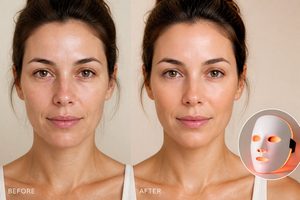
You put serum on your face every night. Then you stop at the jawline. Months later, the skin on your face looks smoother while your neck starts showing crepey lines and a looser edge along the jaw. That gap is one of the most common reasons women start shopping for an LED face and neck mask instead of a face-only device.
The neck has thinner skin, fewer oil glands, and constant movement from turning and looking down. It ages on its own schedule. Light therapy devices covering both zones in one session treat the face and neck as a single canvas, which is closer to how aging actually shows up.
This guide is built to be read with two product pages open: what the wavelengths do, what separates a well-built device from a weak one, what a complete set really costs against buying the pieces apart, and what to expect once you own it.
Why an LED Face and Neck Mask Covers More Than a Face Device
Treating the face alone leaves a line where care stops. The neck and décolletage often show early crepiness, horizontal lines, and uneven tone before deeper facial wrinkles set in.
Skin structure explains part of this. The dermis thins with age, collagen fibers fragment, and elastin loses its spring across the whole skin organ, not just the parts you moisturize.
The neck simply has less structural cushion to start with, so the same slow loss reads as looseness sooner there than on the cheeks.
Addressing Fine Lines on the Face Without Neglecting the Neck
Fine lines around the mouth, forehead, and outer eye area respond to the same collagen-support mechanism that helps the neck. Treating only the face means half the visible aging zone gets nothing.
Think about where people look during a conversation. The jawline and upper neck sit in the frame the whole time, so smoothing facial texture while skipping that area leaves the two zones on different timelines.
Even coverage from chin to chest is not about a dramatic result. It is about not building a visible boundary at your jaw over the next two years.
Why a Dedicated Neck Device Fits Better Than a Face Mask
A facial mask is molded to sit over the nose, cheeks, and brow. Pressed against a curved neck, it leaves gaps, and gaps mean uneven light delivery.
A dedicated neck mask curves to wrap the throat and lower jaw. The light sits closer to the skin, and the distance stays consistent across the treatment area, which matters because the energy reaching the skin drops off sharply as a panel moves away.
PlushDerm packages separate face and neck devices in one set for exactly this reason. Each piece is shaped for its own zone, and both run the same 620nm red, 460nm blue, and mixed settings.
What Full Treatment Coverage Means in a Single Sitting
One 10-minute cycle covering both areas is one thing to fit into an evening rather than two. That is a practical convenience rather than a measured improvement in results, and it is worth saying plainly, because nobody has studied whether owning a two-piece set makes people keep a routine longer.
Here is what a complete face-and-neck session reaches in a single sitting:
- Forehead, cheeks, and the outer eye area where fine lines form first
- Nose and chin, where oil and visible pores concentrate
- Jawline and upper neck, the first place laxity shows
- Lower neck and upper décolletage, often missed entirely by face-only devices
Coverage only pays off when the wavelengths hitting your skin are the right ones for your concerns.
Two Wavelengths, Two Different Jobs
One of these colors is working on firmness and texture. The other is working on breakouts and oil. They are not two strengths of the same thing, and knowing which is which is most of what you need to choose a mode.
Depth is the reason. Blue stops in the shallow layers where acne bacteria live, while red carries further down to the fibroblasts that assemble collagen and elastin.
Smoother-Looking Skin With 620nm Red Light
Softer fine lines and more even tone are the outcomes red light has been measured against. The 620nm setting on a 620nm red mode sits in the visible red band used in cosmetic rejuvenation research.
One study of a 630 ± 10nm LED mask measured a 47.7% increase in ultrasound-measured dermal density after 84 days of use.* Three things travel with that number: it came from that device at that wavelength, dermal density is a measure of tissue structure rather than a count of collagen your body produced, and the trial had no comparison group, so it shows change over time rather than change against an untreated control.
* Individual results may vary. Findings reference external clinical studies, not PlushDerm-specific trials.
Where the Extra Cellular Energy Goes
Photobiomodulation is the name for the underlying process. Mitochondria, the energy centers inside your cells, absorb the light, and cellular energy output rises as a result.
That extra energy has to be spent on something, and in the dermis a share of it goes to fibroblasts making collagen and elastin, the two proteins behind firmness and bounce. Harvard Health describes red light as believed to stimulate mitochondria in a way that lowers inflammation and lifts collagen production.
That same review reports the American Academy of Dermatology considers the evidence supportive for reducing fine lines, smoothing texture, and lightening dark spots.
Clearer-Looking Skin With 460nm Blue Light
Blue light is aimed at a different target: Cutibacterium acnes, the bacteria involved in inflammatory breakouts. The 460nm setting works by triggering compounds inside the bacteria that damage it from within.
Published work has examined self-applied blue light for mild-to-moderate facial acne, and a 460nm blue setting is also marketed for oil control and the look of enlarged pores. The bacterial evidence is the stronger of the two; oil and pore claims rest on less.
If both aging and breakouts are on your list, a mode that runs both wavelengths covers 620nm and 460nm in one cycle.
Why One Study Does Not Cover Every Device
Published studies test specific wavelengths, doses, and devices. A result from a 630nm mask does not automatically transfer to every red LED on the market, and this is the single most common way product pages overstate their case.
Near-infrared (NIR) wavelengths, around 800 to 850nm, penetrate deeper than visible red and appear in some professional panels. Visible red at 620nm and NIR are studied separately and should not be quoted as if they were interchangeable. A set of LED study summaries is worth reading as research on the technology rather than as testing of any one product.
Dermatologists also note that at-home devices vary widely in output, so dose is genuinely hard to pin down across brands. That variability is exactly why build specs deserve a close read.
What to Compare Before Choosing an At-Home Device
Four things separate a device worth $350 from one worth skipping: the wavelengths listed, the fit against your skin, the power source, and what is actually in the box. Everything else is packaging.
Start with published specs. A brand that will not name its wavelengths in nanometers is asking you to trust a color rather than a measurement.
Wavelengths, LED Bulbs, and Treatment Time
Look for stated numbers. The set discussed here publishes 620nm for red and 460nm for blue, with a third mode running the two together.
LED bulb count and spacing affect how evenly light lands. Densely spaced bulbs across a molded panel deliver steadier coverage than a few bright points, though bulb count alone is a weak proxy for the dose reaching your skin and is quoted in marketing more often than it deserves.
Treatment time should be fixed and automatic. Each cycle runs 10 minutes and then shuts off, which removes the guesswork about dose that open-ended devices leave to the user.
Fit, Medical-Grade Silicone, and Eye Protection
Flexible medical-grade silicone conforms to facial curves without pressure points. Rigid plastic shells hold light at an uneven distance, especially around the nose and jaw.
Eye protection is the one thing here not to improvise on. At least one case of photochemical retinopathy has been linked to a blue LED face mask where eye shields were used improperly, according to dermatology experts reviewing at-home LED safety. Requirements differ by product, so follow the instructions for your own device every session rather than assuming shields came in the box.
Check these fit and safety details before ordering:
- Silicone or flexible panel that molds to the face and wraps the neck
- Clear instructions for eye protection on blue and mixed settings
- Automatic shutoff at the end of each cycle
- Weight light enough to wear while moving around the house
Rechargeable Power, Battery Life, and Everyday Portability
The power source sets the boundaries of where a session can happen, without ever appearing on the front of the box. Anything drawing from a wall socket keeps you within a cord’s length of one for the full cycle.
What arrives here is two USB-rechargeable batteries alongside the pair of devices, plus the cables and a dual charger to feed them. Each device draws from a battery pack rather than the wall, so the session travels as far as you do inside the house.
Two batteries also mean one can charge while the other is in use, which is a convenience rather than a result. Nobody has measured whether it changes how often people actually run a session.
How to Judge Value in a Face-and-Neck Set
Compare complete packages, not single pieces, because this is the category where the sticker price and the real price diverge most.
Omnilux, one of the better-known names in at-home LED, sells its Contour Face mask and its Contour Neck and Décolleté wrap separately at $395 each before discounts, so full coverage from that line is $790 in two purchases. PlushDerm’s complete set is $350 and includes the face device, the neck device, both batteries, both cables, and the dual charger, with five trees planted for every order.
Whatever you compare, price the coverage you actually want rather than the cheapest piece of it.
How to Use Light Therapy Safely and Set Realistic Expectations
Clean, dry, bare skin and a steady schedule produce the changes people describe. Light has to reach the skin, so serums, sunscreen, and makeup come off first.
Nothing about LED therapy is a substitute for dermatological care. Treat it as a cosmetic routine addition you control at home.
Getting a Session Right From the First One
Bare skin, nothing on it, light straight onto it. Cleanse and dry first, and save every product for afterward. The published setup and mode-selection steps cover battery connection, choosing a mode, and placement.
Two sessions a week at 10 to 20 minutes is where the manufacturer says to begin. Going past two is not a question the research has answered, so let your own device’s documentation decide it rather than an article.
Serum and moisturizer go on once the cycle ends. The reason for that order is the clear path in, not any change in how absorbent your skin is afterward, which gets claimed often and rests on nothing.
What Changes First, and How Slowly
Changes come gradually. Harvard Health reports that home devices must be used multiple times a week for four to six months to be effective, which is a longer commitment than most product pages imply.
Surface texture and evenness of tone tend to shift before fine lines do. Blemish activity and oiliness often move on a shorter timeline than wrinkles, since bacteria respond faster than collagen rebuilds.
Results vary with age, skin type, sun exposure, and how consistently you keep the schedule.
When to Check With Someone First
Run this list before your first session, and make a call if anything on it applies:
- Sensitive skin or an existing skin condition
- A history of skin cancer
- Pregnancy
- Photosensitizing medications, including certain antibiotics and retinoids
- Light-sensitive conditions such as lupus
- Darker skin tones, since visible light can contribute to dark spots in some people
If redness, itching, or anything else appears and has not faded by the next day, put the device away until someone has looked at it.
Reading Your Own Photos More Honestly Than a Brand’s
Take photos in the same spot, at the same time of day, under the same light, with no makeup. Daylight from the same window at the same hour is the easiest constant to hold onto.
Shoot every two weeks rather than daily. Skin changes too slowly for a day-to-day comparison to show anything except shifts in lighting and mood.
Every brand’s photos carry an individual-results disclaimer for a reason, and that includes this one. Your own two-week series tells you more about your skin than anyone else’s set ever will.
Buy the Coverage, Not the Mask
Full-coverage light therapy makes sense for one unglamorous reason: aging does not stop at the jawline, and a device that does will eventually show you where it stopped.
The mechanics are not complicated. One setting is aimed at the collagen under a fine line, the other at the bacteria inside a breakout, and the third runs them together for skin doing both at once.
So the comparison worth making is not bulb counts. It is the price of covering everything you actually want covered, here against anywhere else. The paired face and neck set from PlushDerm puts both devices and two rechargeable batteries at $350. Read what buyers say months in, then see the complete package and start with two sessions this week. Individual results may vary.
Frequently Asked Questions
Will a Face Mask Cover My Neck if I Just Move It Down?
Not well. A face mask is molded for a flat-ish plane with a nose in the middle, and the neck is a cylinder, so pressing one against the other leaves gaps where the light sits too far from the skin to do much. A dedicated neck device wraps the throat and jawline at a consistent distance. That is why complete sets include a separate neck unit rather than a longer mask.
What Should I Look for in a Neck Device Specifically?
Three things the face-mask spec sheet will not tell you. Whether it wraps far enough around the sides of the throat, where lines actually run, rather than covering only the front. Whether it flexes in two directions, since the neck curves both ways at once. And whether it reaches down to the collarbone, because the décolletage takes the same sun damage and is usually left out.
Is a Two-Device Set Worth It Over a Face Mask Alone?
It depends entirely on whether the neck is a concern for you yet. If it is not, a face device does the job,b and you can add coverage later. If it already is, buying the pieces separately from most brands costs considerably more than a set, so the set is the cheaper route to the same coverage. What a set does not do is work faster or better on the face than a face device would.
Do I Have to Treat Both Areas Every Session?
No, and there is no evidence either way on whether it matters. Both devices in a paired set run the same modes, so treating both is a matter of running them together rather than a separate commitment. If you are short on time, the honest answer is that a session you actually do on one area beats a session you skip on two.
Does the Neck Need a Different Wavelength Than the Face?
No. Neck skin is thinner and more sun-exposed, but it is the same tissue with the same fibroblasts, and 620nm red addresses the collagen side in both places. What differs is the fit of the device and how much attention the area has had over the years, not the setting you choose.