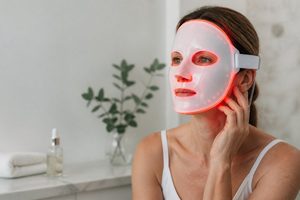
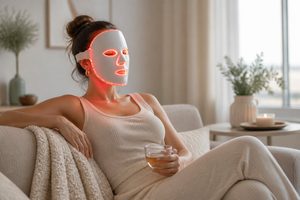
You bought the mask, or you are close to buying one, and you want a straight answer about timing. How long does red light therapy take to work? In the research, changes in skin tone and texture tend to appear around four weeks of regular use, with fine lines and firmness measured in studies running eight to twelve weeks. Individual results may vary; findings reference external clinical studies, not PlushDerm-specific trials.
That timeline sounds slow because it is honest. Red light works through cellular processes that build on themselves, not through anything that shows up overnight. Harvard Health puts the bar higher still, reporting that devices “must be used multiple times a week for four to six months” for meaningful change, according to dermatologist Dr. Rachel Reynolds in a review of red light therapy for skin care.
Those two numbers are not in conflict, and the gap between them is worth understanding before you start counting weeks. This guide covers what the research actually measured at each stage, what a first-time user can reasonably expect, and which factors move your own date forward or back.
What Research Can and Cannot Tell You About Results
Clinical research supports red light therapy for cosmetic skin goals like fine lines, skin tone, and skin texture. That research studies wavelengths and protocols, not individual products on the market.
Red light therapy is known medically as photobiomodulation, or PBM. It uses red light in the 620 to 700 nanometer range and near-infrared light above 700 nanometers. A clinical overview of photobiomodulation in dermatology describes it as a noninvasive phototherapy delivered through low-level lasers or light-emitting diodes, also called LEDs.
How Photobiomodulation Supports Cellular Activity
Light in the red range is absorbed by mitochondria, the parts of your cells that produce energy. That absorption increases adenosine triphosphate, or ATP, which fuels cellular repair and collagen synthesis.
Three downstream effects matter for skin appearance:
- Higher cellular energy production, which supports faster cell turnover and repair
- Increased circulation, delivering more oxygen and nutrients to skin tissue
- Reduced inflammation, which softens redness and calms irritated areas
Collagen remodeling follows this chain. Fibroblasts produce more collagen when energy supply rises, and collagen density builds over weeks, not days.
Why the Timelines You Read Do Not Match Each Other
Here is the reconciliation promised above. Clinical studies typically run 8 to 12 weeks because that is long enough to measure a change against a control and short enough to keep participants enrolled. Harvard’s four-to-six-month figure is different guidance for a different question: not when an instrument can detect a difference, but when a person should expect to see one in the mirror and decide whether the device was worth buying.
So both are accurate. The studies tell you when the biology has moved. Harvard tells you when you can fairly judge it. If you are counting weeks, count toward the longer number.
Why Cosmetic Research Is Not Proof for Every Red Light Therapy Device
Studies test a specific wavelength, a specific irradiance, and a specific session length. A device that emits 620nm red light uses a studied wavelength. That is different from the device itself being clinically tested.
Treat published findings as evidence for the technology. Ask any brand what its own device delivers, then judge the fit yourself.
Why Individual Results and Study Protocols Matter
Study participants follow strict schedules. Real users skip sessions, change routines, and start from different baselines.
Age, skin type, sun damage history, and starting collagen levels all shift how quickly visible change appears. Your timeline may run ahead of or behind the averages published in research.
A Realistic Timeline for Cosmetic Skin Changes
Early changes show up in skin tone and hydration, while structural changes like fine lines take much longer. A 2023 study on red-light photobiomodulation found reversal of visible aging signs that lasted up to one month after participants stopped using the mask, according to research on reversing skin aging signs with photobiomodulation.*
* Individual results may vary. Findings reference external clinical studies, not PlushDerm-specific trials.
One rule governs everything below: where the research measured something at a given point, this guide says so, and where it did not, it says that instead. Checkpoints without evidence behind them do not get assigned a benefit.
What You May Notice in the First Two Weeks
At two weeks, most reported changes are surface-level. Skin often looks less dull and feels more hydrated after a session, partly from increased blood flow.
Published cosmetic research does not assign measured wrinkle reduction to the two-week mark. Treat anything you see this early as encouraging rather than conclusive, and expect it to be the kind of change that fades between sessions rather than accumulating.
Common early observations include:
- A temporary glow lasting several hours after a session
- Less visible puffiness, especially in morning sessions
- Calmer redness in areas prone to irritation
- Fewer new breakouts when blue light is part of the routine
What May Change Around Four Weeks
Four weeks is when changes in skin texture become easier to photograph. Cell turnover has cycled through at least one full renewal period, so the surface reflects light more evenly.
Skin tone often reads as more even at this stage. Hyperpigmentation fades slowly and rarely shows dramatic change this early.
Sessions matter here more than session length. A device that runs a 10-minute cycle and shuts off automatically makes four consistent weeks realistic for a busy schedule.
What Eight to Twelve Weeks of Consistent Use May Show
This is the window where studies have measured collagen-related change. Sustained treatment across roughly this length is where researchers have picked up shifts in the biomarkers associated with collagen building.
Fine lines around the eyes and mouth are where softening tends to register first, because the skin there is thinnest. Firmness along the jaw and neck is slower again, and it’s worth noting that a face-only device leaves the neck out of your comparison entirely.
What the research does not offer is a guarantee attached to any particular week. The window is where measurable change has been found, not a date it arrives for you.
Why Your Results May Arrive Sooner or Later
Two people using the same device on the same schedule can land weeks apart. Session frequency, device output, and total accumulated dose explain most of that gap.
How Session Frequency and Treatment Consistency Affect Progress
Cumulative dose drives results, and this is where a distinction matters that product pages tend to blur. Clinical protocols often run three to five sessions per week, because they are built to produce a measurable effect inside a study window. PlushDerm’s own published guidance is different and more conservative: start with two sessions a week of 10 to 20 minutes, with each cycle fixed at 10 minutes.
Follow the instructions that came with your device rather than a trial protocol, and do not treat a research schedule as a target to escalate toward. If you want to change your frequency, that is a conversation for your device’s documentation or a professional, not something to infer from a study.
Missing a week does not erase progress. It does push your visible-results date further out, which frustrates people who started counting from day one.
Why Device Quality, Verified Wavelengths, and Irradiance Matter
Wavelength accuracy decides whether light reaches the right cellular targets. Irradiance, measured in milliwatts per square centimeter (mW/cm²), decides how much energy arrives per minute.
Check these before you buy:
- Published wavelengths, such as 620nm for red and 460nm for blue
- Coverage area, since a face-only panel leaves the neck untreated
- Treatment distance, because output drops sharply as the device moves away from skin
- Power source, since a unit that must stay plugged in decides where your sessions happen
Masks that rest directly on the face keep distance consistent. That removes one of the biggest sources of variability in at-home use.
Why More Light Is Not Always Better
Photobiomodulation follows a biphasic dose response. Too little light produces no effect, and too much can reduce the benefit rather than increase it.
This is why automatic shutoff after a set cycle is a feature, not a limitation. Running three back-to-back sessions to speed things up works against the biology.
Red Light vs. Blue Light: Why Goals Change the Timeline
Different wavelengths solve different problems on different schedules. Matching the mode to your goal prevents the disappointment of waiting for a result the light was never going to deliver.
Red Light for Surface-Level Cosmetic Skin Goals
Red light at 620nm targets collagen support, skin tone, skin texture, fine lines, and wrinkles. It works in the dermis, where fibroblasts live, and its timeline is the eight- to twelve-week range described earlier.
The 620nm setting is the one to choose when aging concerns top your list.
Blue Light for Blemish-Prone Skin and Oiliness
Blue light shows results faster because it acts on bacteria at and near the surface rather than on structural protein underneath. A 460nm setting addresses acne-causing bacteria and, on lighter evidence, oiliness.
Meta-analysis of at-home low-level blue and red light devices has reported significant improvements in acne and skin appearance measures. Blemish improvements often appear within four to eight weeks, ahead of wrinkle changes, which is worth knowing if you are running both modes and wondering why one seems to be doing more than the other.
Running both wavelengths together in a combined mode suits skin dealing with breakouts and early lines at the same time.
Why Near-Infrared Light Is a Different Question
Near-infrared light sits above 700nm and travels deeper than visible red, which is why it appears in research aimed at tissue below the skin rather than at its surface. Those applications follow their own schedules and generally need clinical-grade output.
For the purposes of this timeline, the point is simply that a cosmetic face mask is built for tone, texture, and fine lines, and near-infrared findings do not transfer to it. If a product page cites near-infrared research to support a facial claim, that is a gap worth noticing.
How to Track Progress and Use Light Therapy Responsibly
Photos taken under identical conditions are the only reliable way to judge slow cosmetic change. Memory is a poor judge of gradual improvement.
How to Take Useful Before-and-After Photos
Shoot on day one, then every two weeks. Use the same spot, same time of day, same light source, and no makeup.
Keep your expression neutral and take one straight-on shot plus one at 45 degrees on each side. Small differences in angle can fake improvement or hide it.
How to Build a Simple, Consistent Routine
Cleanse first so light reaches bare skin. Apply serums and moisturizer after the session, not before, unless your device instructions say otherwise.
PlushDerm’s operating guide covers connecting each device to its battery by cable and starting a cycle. Its published starting point is two sessions per week of 10 to 20 minutes, and that is the number to build a habit around.
Pair light therapy with the basics that support skin health: daily sunscreen, adequate sleep, and a diet with enough protein for collagen production. Retinoids and light therapy can coexist, though sensitive skin may need them on alternate evenings.
When to Pause Use and Speak With a Healthcare Professional
Stop if you experience persistent redness, stinging, or any adverse reaction, and let your skin settle before resuming. LED masks are cosmetic devices, built to affect how skin looks rather than to treat anything.
Several situations warrant professional input before your first session: reactive skin, a diagnosed skin condition, pregnancy, medications that increase light sensitivity, or any history of skin cancer. Harvard Health also advises caution with darker skin tones, recommending lower starting doses.
Consistency Gives Cosmetic Results Time to Build
Red light therapy rewards patience on a schedule. Two weeks brings glow and hydration that comes and goes, four weeks brings skin texture and tone changes worth photographing, and eight to twelve weeks is the window where studies have measured collagen-related change. Four to six months is when you can fairly judge the purchase.
The factors you control are frequency, wavelength accuracy, and coverage. A device that publishes its 620nm red and 460nm blue output, used on the schedule its own instructions set, gives you the clearest read on whether the routine is working for your skin.
Counting weeks is easier when both areas are in the same photograph. The face and neck set delivers both wavelengths across both areas for $350 all-in, with two rechargeable batteries so a session is not anchored to a wall outlet. The research summaries are worth reading first, and so are the accounts from people who have used it for months. Individual results may vary.
Frequently Asked Questions
Why Does Harvard Say Four to Six Months When Studies Show Twelve Weeks?
Because they answer different questions. Clinical studies run 8 to 12 weeks because that is long enough for instruments to detect a difference against a control. Harvard’s longer figure is about when a person can fairly judge whether a device is worth keeping. If you are deciding whether yours works, count toward four to six months.
Is 10 Minutes of Red Light Therapy Enough?
Yes, a 10-minute cycle is a standard cosmetic session length for at-home LED masks. Total weekly dose matters more than any single session, so three 10-minute sessions beat one 30-minute session.
How Can I Tell if Red Light Therapy Is Working?
Compare photos taken every two weeks in the same lighting, angle, and time of day. Look for evenness in tone and smoother skin texture first, since those change before wrinkle depth does.
What If I Have Seen Nothing After Six Weeks?
That is within normal range rather than evidence of failure. Six weeks sits before the window where studies measure structural change, and well before the four-to-six-month point dermatologists describe. Check your photos against your day-one baseline rather than your memory, and confirm you have been running sessions on bare skin, since products left on will scatter the light.
Does Missing a Week Undo My Progress?
No. Skipping sessions does not reverse what has already built, but it does push your visible-results date further out, because the effect depends on accumulated dose rather than elapsed calendar time. Restart on your normal schedule rather than doubling up to compensate.
Should I Increase to Daily Sessions to Speed Things Up?
No. Photobiomodulation follows a biphasic dose response, meaning excessive exposure can reduce benefit instead of adding to it. Follow the frequency your device’s own instructions specify rather than a schedule borrowed from a clinical trial, and stop if you notice persistent redness or irritation.