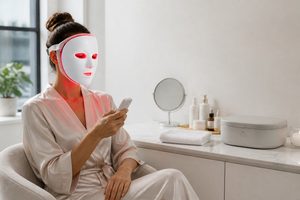
You have been comparing LED masks for weeks, and every product page sounds the same. Each one promises firmer skin, fewer breakouts, and results in days. What you want is a way to tell which claims hold up and which are marketing polish on a plastic shell.
Searching for esthetician LED light therapy is a reasonable instinct, because a licensed skin professional spends her working week with this equipment on other people’s faces. She is not reading the box. She is watching what a device does, how it sits, and whether a client comes back having actually used it.
This guide sets out the criteria that decide those things: the exact wavelength, how much skin the panel covers, how long a cycle runs, how the claims on the label are worded, and what a professional can and cannot tell you about a device she has not tested herself.
The Esthetician LED Light Therapy Checklist for At-Home Masks
Start with the spec sheet, then work outward to fit and usability. Wavelength, treatment area, session length, and what happens if the device fails tell you more than any before-and-after gallery.
That order matters because light therapy is dose-driven. Skin responds to a specific wavelength delivered at a workable intensity over repeated sessions. A device that gets the wavelength right but covers half your face still leaves you running two sessions to treat one area.
Professional machines and portable masks are built on the same principle, photobiomodulation, which means using light to influence cell activity. The difference shows up in dose control, panel size, and how much of the session someone else manages for you.
A Color Is Not a Specification
A label that says “red light” tells you almost nothing. The nanometer figure tells you what part of the spectrum the diodes emit, and that number is what researchers actually test.
Published photobiomodulation reviews define red light as the 620 to 700 nanometer range and near-infrared as 700 to 1440 nanometers. Blue sits lower, near 400 to 470 nanometers. When a brand lists only a color, there is no study you can match it to, and that is usually the point.
PlushDerm publishes 620nm for red and 460nm for blue, both inside the ranges used in published LED research. Listing a figure at all is a baseline honesty signal rather than a selling point, because it is the one claim on the box you can go and check yourself.
Ask for these specs before anything else:
- The exact nanometer figure for each light mode
- Whether that wavelength applies to the whole panel or a subset of diodes
- Session length per cycle and whether the device shuts off on its own
- Whether the manufacturer publishes the research it references
Once you can read a spec sheet, the next filter is how much skin the device treats in one sitting.
How Coverage, Fit, and Treatment Area Affect Practical Use
Treatment area decides how long your routine takes. A panel covering the full face finishes in one cycle. A handheld wand treating a few inches at a time turns a 10-minute session into a 30-minute chore, and that is the kind of detail that only shows up after you own the thing.
The neck is where most face-only masks stop. Skin there is thinner and shows crepiness and horizontal lines early, so treating above the jaw for two years and not below it eventually shows you where you stopped.
Fit is the second half of coverage. A rigid shell floating above your cheekbones delivers less light to the skin than a panel sitting close and even. If a mask slides when you talk or lean forward, that is a design problem you will be negotiating with twice a week.
Why Irradiance, Timers, and Support Matter
Irradiance is the amount of light energy hitting your skin per square centimeter, and it sets your dose alongside session time. Two masks at the same wavelength can behave differently if one runs weaker diodes, which is the variable almost no consumer page publishes.
Harvard Health notes that home devices vary in light strength, which makes exposure hard to estimate, and recommends looking for a device labeled FDA-cleared so you know the agency reviewed it for safety. Fixed automatic timers help with the same problem from the other end. When a cycle ends on its own, your dose stays the same every session rather than depending on whether you lost track of time.
A fixed 10-minute cycle that ends itself is the version of this to look for. Beyond that, ask what happens when something breaks, how long support lasts, and whether the return window is long enough to actually test consistency, since nothing here reveals itself in a fortnight.
Portable Masks vs. Professional LED Equipment
Professional equipment wins on dose control. Harvard Health reports that clinic devices can better control the dose and offer a wider range calibrated to the condition being treated, and a trained operator adjusts distance and duration per client.
At-home masks win on frequency. The research points to repeated use over months, and Harvard Health puts the requirement at multiple sessions a week for four to six months. Booking that many appointments is not realistic for most people, and a treatment you cannot sustain is not a treatment.
That trade is the actual decision. One is better per session; the other is the one you will still be doing in March.
Which LED Light Colors Match Common Skin Goals?
Red is the setting for aging concerns. Blue is the setting for breakouts. Which you need depends on whether your main complaint is texture and firmness or clogged, oily, blemish-prone skin.
The mechanism differs for each. Red light is absorbed by mitochondria, the energy centers inside cells, which is thought to reduce inflammation and support collagen production. Blue works at the surface, on bacteria that contribute to acne.
Both are visible light, so neither carries the skin cancer risk associated with ultraviolet exposure. That safety profile is a large part of why LED therapy moved out of clinics and into bathrooms as quickly as it did.
Red Light at 620nm for Fine Lines and Skin Rejuvenation
Fine lines, uneven texture, and lost firmness are the red band’s territory. Research summarized by the American Academy of Dermatology suggests it can soften lines and wrinkles, even out texture, lighten dark spots, and take down redness.
The mechanism runs through cell energy. Red light is believed to stimulate mitochondria, lowering inflammation and lifting production of collagen, the structural protein that keeps skin firm. More collagen and elastin support means better resilience over months of use, with the emphasis on months.
The 620nm red mode discussed here sits at the low end of the red band used in photobiomodulation research. Results build slowly enough that Harvard Health frames the commitment in seasons rather than weeks.*
* Individual results may vary. Findings reference external clinical studies, not PlushDerm-specific trials.
Blue Light at 460nm for Breakouts and Surface Bacteria
Blue light reduces breakouts by targeting the bacteria associated with acne. It is absorbed by compounds inside those bacteria, which disrupts them at the skin surface without a topical antibiotic.
Published work on at-home devices has tested once-daily 10-minute treatments combining blue and red light, applied to the face in a single step. That is a useful reference point for what a studied protocol looks like, and also a reminder that the studied protocol is rarely the one on your box.
A 460nm blue mode is typically presented for oil control and the appearance of pores alongside blemish-prone skin. Blue light does not stimulate collagen. That work belongs to red, and a device sold on its blue setting is not an anti-aging device.
The Case for Running Both at Once
A combined setting suits skin dealing with two things at once: active breakouts plus early fine lines, or oiliness plus dullness. You treat both in the same session rather than alternating nights.
The pairing has been tested in acne research, including a four-week trial of a low-level blue and red mask in subjects with mild to moderate acne who described their own skin as sensitive, using simultaneous exposure in one step.
A mode running 620nm and 460nm together exists for people who want both, and combined modes suit maintenance well once a primary concern has settled.
What Red, Blue, and Infrared Light Can and Cannot Address
LED light therapy addresses appearance-level concerns. It does not replace prescription acne treatment, in-office laser work, or medical care for a diagnosed condition.
A practical split:
- Red at 620nm: fine lines, skin texture, firmness, redness, dullness
- Blue at 460nm: acne-causing bacteria, excess oil, appearance of pores
- Near-infrared, 700nm and above: deeper tissue applications, studied separately from visible red
- Beyond LED scope: cystic acne, active rosacea flares, suspicious moles, deep scarring
Photodynamic therapy sits in a different category entirely. That clinic procedure applies a light-sensitizing solution to the skin first, which the American Academy of Dermatology notes must sit for 15 minutes to 3 hours before light exposure. It shares a vocabulary with at-home masks and almost nothing else.
Knowing the ceiling on LED claims makes it easier to spot which endorsements carry weight.
How to Separate Professional Guidance From Marketing Claims
Check who is making the recommendation and what credential sits behind it. A licensed esthetician endorsement, a dermatologist recommendation, and a paid influencer post are three different things wearing similar language.
The gap is widest online, where most of what circulates about light therapy comes from accounts with no clinical credential at all and considerably larger audiences than the credentialed ones. That is not an argument to distrust everything; it is an argument to look at who is talking before you weigh what they said.
What “Esthetician Approved” Actually Tells You
An esthetician-approved label means a licensed skincare professional reviewed and endorsed the device. Estheticians are state-licensed to perform facials and non-medical skincare treatments, so the perspective they bring covers usability, comfort, and how a device fits into a client’s routine. That is real information, and it is information most product pages never provide.
It does not mean a physician evaluated the device, and it does not mean the device passed a clinical trial. Those are separate standards with separate evidence behind them.
The practical test is whether the endorsement names anyone. A label crediting identified, licensed professionals can at least be asked about. A floating “esthetician approved” badge with no names behind it is a graphic, not a claim.
What Makes a Mask Dermatologist-Recommended?
A dermatologist-recommended mask has a documented endorsement from a board-certified dermatologist or a dermatology organization, tied to that specific product. Anything less is a phrase borrowed for marketing.
Watch for three substitutions:
- Citing general LED research and implying it validates the product
- Quoting a physician who reviewed the category, never the device
- Using “dermatologist tested” where no dermatologist endorsed anything
PlushDerm’s own endorsements come from licensed estheticians, which is a different credential from a dermatologist’s and is worth reading as exactly what it is. Any brand, this one included, that lets the two blur together is asking you to hear a claim it has not made.
How to Read Clinical Research Without Overpromising Results
Look for four things in any cited study: the wavelength, the number of participants, the length of the trial, and whether the device tested matches the one being sold. If any of those are missing, treat the claim as unproven rather than disproven.
Photobiomodulation research is genuinely encouraging. Reviews report that light in the red and near-infrared range, delivered by low-level lasers or light-emitting diodes, treats a range of dermatologic conditions effectively.
Dose is where it gets uncertain. Harvard Health notes that scientists have not determined how long each session should last or what dose suits which skin issue. A brand promising a precise outcome on a precise schedule is stating more than anyone currently knows.
What you want to find is study summaries offered as a picture of the category, with no suggestion that any of it was run on the device in front of you.
The Distinction That Trips Up Most Shoppers
Research on red and blue LED light generally is not clinical testing of any individual consumer mask. A study showing 620nm light supports collagen production tells you about the wavelength. It tells you nothing about the device on your screen.
Device-specific proof requires that exact product tested on human subjects with published results, and most at-home masks do not have it. What an honest brand does is say so.
The framing to expect is a description of citations as research on LED light therapy in general, not as clinical testing or regulatory approval of the product being sold. Anything that blurs the line deserves a second look, and the blurring is usually done with a verb rather than a number.
Can Sensitive or Acne-Prone Skin Use LED Light Therapy?
Sensitive and acne-prone skin generally tolerates LED light therapy well, since visible red and blue produce no heat damage and no ultraviolet exposure. What research reports on the downside is thin and unalarming: some temporary redness, nothing lasting.
Tolerance has been looked at directly in this group. The four-week acne mask trial mentioned earlier enrolled subjects who described their own skin as sensitive, which is a narrower and more useful finding than a general safety statement.
Caution still applies in specific situations. Harvard Health advises avoiding use if you have a light-sensitive condition such as lupus or take light-sensitive medications like certain antibiotics.
Setting Realistic Expectations for Sensitive Skin
Start at the published starting point, which is two sessions per week, and let your own device’s documentation decide anything beyond that. No published research establishes an escalation schedule for sensitive skin, so any article handing you one has written it themselves.
Skip actives on treatment nights while you are starting out. Retinoids, strong acids, and benzoyl peroxide already ask a lot of the barrier, and stacking them with a new device makes it impossible to work out what caused a reaction if one appears.
Eye protection deserves the same literal treatment. Keep light out of your eyes and use whatever shields your device’s instructions specify, checking whether it ships with any, since that varies by product.
Sensitive skin, a skin condition already under treatment, pregnancy, photosensitizing medication, or a history of skin cancer are each a reason to get a professional opinion before the first session. PlushDerm’s own pages say the same.
When Uneven Tone and Pigmentation Need Professional Advice
Uneven tone and hyperpigmentation respond differently depending on skin type, so get professional input before starting rather than after. Visible light can trigger dark spots in some people.
Harvard Health is direct on this: check with your dermatologist beforehand if you have darker skin, since you may be more sensitive to visible light, and start with lower doses. That is a dosing adjustment rather than a warning off.
Sun damage is a long game either way. Improvements in texture and dark spots accrue over months of consistent use alongside strict sun protection, which light therapy complements rather than replaces.
When Rosacea, Severe Acne, or Skin Conditions Need a Dermatologist
Rosacea, cystic acne, and any diagnosed skin condition belong with a dermatologist first. LED masks are cosmetic devices, not medical ones.
Severe acne has options home LED cannot match. Clinical reviews of acne therapy cover photodynamic therapy, intense pulsed light, pulsed dye laser, and newer fiber-coupled diode lasers, all administered under medical supervision.
Signs it is time to book an appointment:
- Painful, deep nodules or cysts that leave marks
- Persistent flushing, visible vessels, or burning
- Acne scars you want actively treated, not just softened
- Any mole or lesion that changes in size, color, or shape
- Skin that reacts badly to your current device or products
If your skin reacts, put the device away and get someone to look at it. Manufacturer terms generally say to discontinue immediately, and that means the device goes, not that you rearrange everything else around it.
How to Add a Mask to a Simple Routine
Use the mask on clean, dry, bare skin. Cleanse first, leave serums and moisturizer until after, then apply your regular products once the cycle ends.
Timing is flexible, and evening works well because you are already settled. The setup and mode-selection guide covers connecting each device to its battery and choosing a mode.
Two sessions per week of 10 to 20 minutes is the published pace. More frequent sessions are not established as better, and the honest position is that nobody has worked out the optimum.
Choosing a Mask You Will Still Be Using in Month Four
The device used twice a week beats the stronger one used twice a month, and that is less a motivational line than an arithmetic one. Coverage, portability, and a session length you can absorb into an existing routine are what decide it.
Harvard Health sets the bar plainly: multiple sessions a week for four to six months. Any friction in your setup compounds across that timeline, which is why comfort and fit belong on a spec comparison rather than in the nice-to-have column.
Why Face and Neck Coverage Belongs in the Comparison
Neck skin ages visibly and often ahead of facial skin, because it is thinner and receives a fraction of the sunscreen. Treating one area and skipping the other eventually draws a line you can see.
Most LED face masks stop at the jaw, and buying a matching neck unit separately means a second purchase and a second session on every treatment night.
A combined set covering both areas runs $350 here, with two USB-rechargeable batteries, two charging cables, and a dual charger. Whether that matters to you depends entirely on whether your neck is a concern yet; if it is not, a face device is enough.
What Battery Power Changes, and What It Does Not
Battery power lets you run a session while you move around the house. Each device connects to its own rechargeable battery pack by cable rather than to the wall, so a treatment is not confined to whichever chair is nearest a socket.
A wall-powered mask holds you in one spot for the full cycle. A battery-powered one lets you fold laundry or read through the 10-minute window instead.
Whether that changes how often anyone actually runs a session has not been measured, so treat it as a convenience that removes an obstacle rather than as a result you are buying.
Questions to Ask Before Comparing Price and Returns
Compare total cost rather than headline price. A cheaper face-only mask plus a separate neck unit often costs more than a combined set.
Run through this list before you buy:
- Does the price include both face and neck coverage?
- Are batteries, cables, and chargers included, or sold separately?
- How long is the return window, and who pays return shipping?
- What does the warranty cover, and for how long?
- Are there consumable parts or subscription fees?
- Does the brand publish exact wavelengths and session length?
The last one is the fastest filter. A brand that publishes its nanometer figures has given you something to check; a brand that does not has given you an adjective.
What a Beginner-Friendly Schedule Looks Like
Twice weekly, 10 to 20 minutes at a time, is what manufacturers publish for new users. Each cycle is 10 minutes and ends by itself, so the upper figure means running two.
Pick fixed days rather than a vague three-times-a-week intention. Monday and Thursday evenings hold up better than good intentions do.
Changes in tone and texture tend to show before changes in fine lines, and four to six months is the realistic horizon. Individual results may vary.
* Individual results may vary. Findings reference external clinical studies, not PlushDerm-specific trials.
Four Checks, and Everything Else Is Packaging
The buying decision comes down to four things: published wavelengths, coverage that includes whatever you actually want treated, a fixed session timer, and a return window long enough to test consistency. Everything else on the box is secondary.
One number on the box is about the collagen under a line. The other is about the bacteria inside a breakout. A combined mode runs both. An esthetician endorsement tells you a licensed professional found the device workable, which is worth having and is not the same as clinical proof, and the brands worth trusting are the ones that draw that line themselves.
PlushDerm’s face and neck set publishes both figures, covers both areas in one session, and runs on rechargeable batteries, at $350 with five trees planted per order. See the complete system if it answers the four checks for you. Individual results may vary.
Frequently Asked Questions
Can Estheticians Do LED Light Therapy?
Yes. Licensed estheticians perform LED light therapy as part of non-medical facials and skincare treatments in most states. Scope of practice varies by state, so the specific services any esthetician can offer depend on local licensing rules, which is also why an esthetician in one state may decline something a colleague elsewhere does routinely.
What Red Light Do Estheticians Use?
Professional equipment works within the red band that photobiomodulation research defines as 620 to 700 nanometers, and the same range applies to at-home devices. The setting discussed in this guide sits at 620nm, at the low end of that studied band. The more useful question is not which number a professional uses but whether the device you are buying publishes one at all.
Is “Esthetician Approved” Worth Anything on a Box?
It is worth something specific and limited. It tells you a state-licensed skincare professional handled the device and found it workable, which covers comfort, fit, and whether it suits a client’s routine. It does not tell you a physician assessed it or that it was clinically trialed. Treat it as evidence about usability, and look for named professionals rather than an unattributed badge.
Should I Trust a Dermatologist Recommendation Over an Esthetician One?
They answer different questions, so it is not really a ranking. A dermatologist’s view carries medical weight on whether light therapy suits your skin and your conditions. An esthetician’s view carries practical weight on whether a particular device is comfortable, well-fitting, and realistic to keep using. The one to be wary of is neither: a product page using medical-sounding language without naming who said it.
What Are the Negatives of LED Light Therapy?
Very little goes wrong physically; redness that fades is the usual extent of it. The real costs are time and uncertainty. Consistent use over several months is required before anything is worth judging, and researchers have not settled on the optimal dose or session length for a given concern, which means every schedule you are given, including this one, is a reasonable starting point rather than a proven protocol.