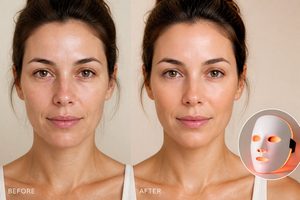
You are tired of waking up to a fresh breakout along your jawline, again. You have tried the drying spot treatments, the clay masks, and the serums that promised clearer skin and delivered peeling instead. Fewer breakouts and calmer, clearer-looking skin are the goal, and you want a method that does not sting or bleach your pillowcase.
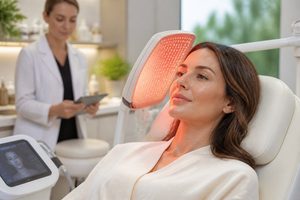
Blue light therapy for acne is one of the most studied non-invasive options you can use at home. It works on acne-prone skin by targeting the bacteria involved in breakouts, using a specific color of light rather than a chemical. Licensed estheticians have recommended light therapy for years, and at-home LED devices now bring a version of that treatment into your bathroom.
Ahead: how blue wavelengths affect acne bacteria, what the clinical research shows for mild-to-moderate acne, and how to build a routine you can stick with. You will leave knowing how studied wavelengths compare to the settings on an at-home light therapy device, what a realistic timeline looks like, and when your skin needs a dermatologist instead.
How Blue Light Targets Acne-Causing Bacteria
Blue light reduces the bacteria that drive inflamed breakouts. It does this through a chemical reaction inside the bacteria themselves, not through heat, peeling, or antibiotics.
The bacteria most linked to acne live in your pores, where oil collects. Blue light penetrates the upper layers of skin and reaches them. What happens next is a reaction the bacteria set up themselves, which is what makes the effect so selective.
That mechanism is why blue light is used for breakouts while other colors of light are used for lines and firmness.
What Is Blue Light Phototherapy?
Phototherapy means using light as a treatment. Light-emitting diode (LED) devices produce a narrow band of visible light at a chosen wavelength, measured in nanometers (nm).
Different wavelengths reach different depths of skin. Blue sits at the short end of the visible spectrum, so it stays near the surface and the upper part of the oil gland. That shallow reach is exactly what makes it useful for acne.
LED phototherapy uses no ultraviolet light and no heat that could burn. As Harvard Health notes in its review of LED light therapy for skin, these devices carry low power and are unlikely to burn skin, though eye protection still matters.
How Porphyrins in C. Acnes Respond to Blue LED Light
The bacterium behind inflamed acne is Cutibacterium acnes, once called Propionibacterium acnes or P. acnes. As it goes about its ordinary metabolism, it manufactures a family of pigment compounds called porphyrins and stores them inside itself.
Those porphyrins are the vulnerability. They are strongly light-absorbing in the blue part of the spectrum, so when blue light arrives, the bacterium is effectively holding its own detonator. Absorbed energy converts oxygen already present into reactive forms, and those reactive molecules attack the bacterial cell membrane from the inside out.
Here is the chain in plain terms:
- Blue light enters the pore and reaches C. acnes.
- Porphyrins stored inside the bacteria absorb the light energy.
- That energy converts nearby oxygen into reactive forms.
- The reactive oxygen damages the bacterial membrane from within.
- Fewer bacteria means less of the inflammation that turns a clogged pore into a red, sore pimple.
The selectivity comes from that stored porphyrin supply. Human skin cells are not carrying the same chemical payload, so the same light that is destructive inside a bacterium passes through your own cells without the equivalent reaction.
Studied Blue Wavelengths vs. a 460nm Blue Light Setting
Most acne research uses blue light with a peak around 415 nm. A well-known randomized trial on blue and red light phototherapy for acne vulgaris treated 107 patients with mild to moderate acne using light peaking at 415 nm.
Porphyrin absorption is strongest near 415 nm, but it does not stop there. A dermatology review of light-based acne therapy describes the clinically used blue range as roughly 415 to 545 nm, with red light falling around 600 to 650 nm.
At-home devices list their own figures. A 460nm blue light setting sits inside that broader studied blue range, while a 620nm red setting sits inside the studied red range. Those numbers describe the hardware. They are not proof that a particular device reproduces a particular trial’s outcome, and a listing that implies otherwise is asking you to bridge a gap the research has not bridged.
Can Blue Light Help With Oiliness and Inflammation?
Blue light may do more than reduce bacteria. Harvard dermatologists note it may reduce activity in the sebaceous glands, the oil glands that plug follicles and start a breakout.
It is worth being precise about how firm that is. Bacterial reduction is the well-evidenced part. Reduced oil production is a plausible additional effect with lighter support behind it, and any claim that runs straight from blue light to visibly smaller pores has stacked two uncertain steps on top of one solid one.
Blue light also appears to carry an anti-inflammatory effect. Reviews of light and laser therapies for acne report that both blue and red wavelengths calm inflammation, which is part of why the two are so often paired.
Bacteria control is only half the picture, though. What that translates into on your face depends heavily on the kind of acne you have.
What Results Can You Realistically Expect?
Expect gradual fading of red, inflamed bumps over several weeks of consistent use, not overnight clearing. Blue light works best on active inflammatory acne and does little for anything that is not bacteria-driven.
Research on at-home LED devices supports moderate benefit for mild to moderate acne. A published systematic review of home-based dermatologic devices rated blue LED and combination blue-red LED devices as moderate quality evidence with favorable safety profiles.*
* Individual results may vary. Findings reference external clinical studies, not PlushDerm-specific trials.
Which Types of Breakouts May Respond Best?
Inflammatory acne lesions respond most predictably. Those are the raised, red, tender spots that form when a clogged pore becomes infected and irritated.
Blue light has a weaker effect on non-inflammatory lesions. Blackheads and whiteheads are plugs of oil and dead skin, and light alone does not clear the plug. The American Academy of Dermatology states this directly: visible light devices can treat pimples but are not effective against blackheads, whiteheads, cysts, or nodules.
- Likely to respond: papules and pustules, general redness, oily areas
- Less likely to respond: blackheads, whiteheads, deep nodules and cysts
- Needs professional care: painful cystic acne, scarring acne, acne that spreads quickly
Adult and hormonal acne along the jaw and chin often includes both inflamed and deeper lesions. Blue light can help the surface spots while your hormonal triggers stay unchanged.
When Might Changes in Acne Lesions Become Noticeable?
Clinical trials on blue light for acne typically run 8 to 12 weeks. A meta-analysis of at-home blue and red light therapy pooled 12-week clinical studies of participants aged 12 to 40 with mild to moderate acne, which is the window worth holding in mind before you judge your own results.*
A practical way to read that timeline:
- Weeks 1 to 2: less shine, sometimes calmer redness on active spots
- Weeks 4 to 6: fewer new inflamed lesions forming
- Weeks 8 to 12: the clearest picture of whether the routine is working for you
Photograph your skin in the same light every two weeks. Acne moves slowly enough that checking daily gives you noise instead of signal, and a photo from six weeks ago is the only honest comparison you have.
What Clinical Evidence Says About Mild-to-Moderate Acne
The strongest support for blue light sits squarely in the mild-to-moderate range. A network meta-analysis found that for mild-to-moderate acne, combined blue and red light and blue light alone ranked among the most effective acne treatments alongside topical combinations and chemical peels.*
Evidence thins out as acne severity rises. Trials rarely enroll people with severe or cystic acne, so there is no reliable number to quote for those cases.
That gap is meaningful. It shapes who should reach for a device and who should book an appointment.
Why Before-and-After Results Vary
Two people can run identical sessions and see different outcomes. Acne severity, hormones, skin type, and how consistently the device is used all shift the result.
Dose matters too. Clinic treatments deliver higher light energy than a portable home unit, so home devices generally trade intensity for frequency and convenience.
Consistency does most of the heavy lifting. Which raises a practical question: what does a routine you can actually keep look like?
How to Use an At-Home LED Device Consistently
Clean, dry skin and a fixed slot in your week are the two things that make an LED routine work. Sessions are short, so the habit is easier to keep than a multi-step topical regimen.
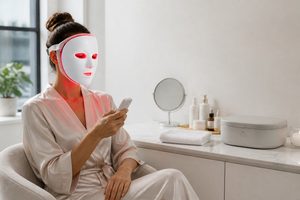
The mechanics are simple. Charge the battery, connect and position the device, choose your mode, and let the timer run.
Most at-home light therapy devices shut off automatically at the end of a cycle, so you are not guessing at duration.
Start With Clean, Dry Skin and the Device Instructions
Wash your face with a gentle cleanser and pat it fully dry. Lotions, oils, and makeup sit between the light and your skin and scatter the wavelength before it reaches the pore.
Apply serums and moisturizer after the session rather than before, so nothing is standing between the light and the pore you are treating.
Then follow the manufacturer’s directions exactly. PlushDerm publishes a step-by-step guide to a light therapy session covering how its face and neck devices connect by cable to portable rechargeable batteries, and each cycle runs for 10 minutes before shutting off on its own.
How Often Should You Use Blue Light at Home?
Start with two sessions per week, each lasting 10 to 20 minutes. That is the starting schedule published on the PlushDerm website, and it is a sensible baseline for acne-prone skin. It is worth keeping that separate in your mind from the protocols used in clinical trials, which were designed to measure an effect rather than to fit a real week.
More is not automatically better. Longer or more frequent sessions do not necessarily improve results, and they give irritated skin less recovery time between treatments.
Build the habit around something you already do. Evening screen time, a podcast episode, or the twenty minutes after you brush your teeth all work.
Give any schedule at least eight weeks before judging it. Stopping at week three tells you almost nothing.
When a Combined Red and Blue Light Mode May Fit Your Routine
Combining wavelengths addresses two problems at once. Blue reduces acne bacteria while red targets inflammation and supports skin repair, which is why researchers have tested the pairing directly in double-blind trials of home-use combination devices.
Choosing a mode is straightforward once you name your main goal. Blue light therapy settings suit oiliness and active breakouts, red light therapy at 620nm supports collagen and skin texture, and a combined setting for breakouts and fine lines serves skin dealing with both at the same time.
Full-Face Coverage vs. Acne Spot Treatment
Full-face masks treat every pore in one session, including the ones about to break out. Handheld acne spot treatment wands only reach the pimple you already have.
That distinction matters for prevention. Breakouts form days before they surface, so treating the whole area catches lesions you cannot see yet.
Coverage below the jaw is worth checking as well. Many devices stop at the chin, while a face and neck mask set treats both areas in one 10-minute cycle without a second purchase.
Even with easy sessions, there are safety points worth knowing before your first use.
Safety, Side Effects, and When to See a Dermatologist
Blue LED therapy is well tolerated for most people, with adverse effects limited to mild, short-lived reactions. Reviews of at-home LED devices consistently report minimal adverse events.
Still, “low risk” is not “no risk.” A few health factors and one specific type of acne call for a conversation with a professional first.
Blue light devices are cosmetic tools, intended to affect how skin looks rather than to treat a medical condition.
Common Mild Reactions and How to Protect Sensitive Skin
The reactions people report are minor and temporary:
- Mild redness right after a session
- Temporary dryness or slight tightness
- Short-lived warmth on the treated area
- Rare stinging on very sensitive or already irritated skin
If your skin runs sensitive, start with the shortest session length and one treatment that week. Watch how your skin looks the next morning before adding a second session.
Skip light therapy over open, broken, or actively peeling skin. Follow every session with a fragrance-free moisturizer to offset any dryness.
Why Eye Protection and Sunscreen Matter
Bright LED light directed at your face is uncomfortable for the eyes and can be a problem for people with underlying eye conditions. Harvard dermatologists specifically advise shielding your eyes during any LED session.
Do what your device’s instructions tell you to do here, because the requirement varies by product and by wavelength. Some devices are supplied with goggles and expect you to wear them, some specify a minimum distance, and some address the eye area directly. Closing your eyes is not a substitute for protection a manufacturer has told you to use. Do not look into the diodes at close range.
Sunscreen belongs in an acne routine regardless. Breakouts fade faster without ultraviolet exposure darkening the marks they leave behind, and daily broad-spectrum SPF 30 protects skin that may be more reactive during treatment.
Medication and Health Factors to Discuss Before Starting
Some medications and conditions make light therapy a poor fit. Check with a healthcare professional before your first session if any of these apply:
- You take a photosensitizing medication, including certain oral antibiotics such as doxycycline or minocycline
- You are using isotretinoin (Accutane) or strong topical retinoids
- You are pregnant
- You have a history of skin cancer
- You have an existing skin condition or a light-sensitive disorder such as lupus
Photosensitizing drugs make skin react more strongly to light than it otherwise would. That is a clinical judgment call, not a guess to make on your own.
Stop using the device and contact a professional if you develop a rash, lasting redness, or any reaction that does not settle within a day.
When Severe or Cystic Acne Needs Dermatological Care
Deep, painful cysts and nodules need medical treatment. Blue light concentrates its energy near the surface, and the inflammation driving a cyst sits well below where those wavelengths reach.
A dermatologist has options a home device cannot match, including prescription topical retinoids, benzoyl peroxide combinations, oral antibiotics managed to limit antibiotic resistance, hormonal therapy, and isotretinoin for severe cases. In-office photodynamic therapy pairs light with a topical agent such as aminolevulinic acid (ALA) for a stronger effect than light alone. The American Academy of Dermatology is direct about the limits here, noting that laser and light treatments for acne rarely clear acne on their own and work best alongside another treatment.
Cystic acne scars if it is left untreated. Getting it assessed early is the difference between temporary marks and permanent texture change, and a home device is better used alongside professional care than in place of it.
A Consistent Routine Is the Practical Path to Clearer-Looking Skin
Blue light therapy for acne earns its place by doing one job well: reducing the bacteria behind inflamed breakouts, session after session. The studied wavelengths cluster around 415 nm, and 460 nm sits within the broader blue range used in clinical practice.
What determines your outcome is whether you use the device on schedule for eight to twelve weeks. Two sessions a week on clean, dry skin, with photos every couple of weeks, will tell you more than any promise on a product page.
For skin dealing with breakouts and early fine lines together, a device offering both 460 nm blue and 620 nm red gives you both jobs in one routine. PlushDerm covers the face and neck in a single set at $350 all-in, running on portable rechargeable batteries so no wall outlet is needed. Reading what buyers report after several months and the research summaries behind these wavelengths is a reasonable next step before you decide.
Breakouts answer to repetition rather than intensity, which makes the first week the least informative one you will have. See the LED face and neck mask and start with two 10-minute sessions this week. Individual results may vary.
Frequently Asked Questions
Does Blue Light Therapy Help With Acne?
Yes, blue light reduces inflamed breakouts by destroying C. acnes bacteria inside the pore. Evidence is strongest for mild-to-moderate acne, where reviews rate at-home blue LED devices as moderate quality evidence. Individual results may vary; findings reference external clinical studies, not PlushDerm-specific trials.
How Often Should You Use Blue Light Therapy for Acne at Home?
Start with two sessions per week, 10 to 20 minutes each, on clean and dry skin. That is the schedule published for PlushDerm devices, and each cycle runs for 10 minutes before shutting off automatically. Using the device more often does not necessarily produce better results.
How Long Does Blue Light Therapy Take to Work for Acne?
Clinical trials on blue light for acne typically run 8 to 12 weeks before measuring outcomes. You may notice less shine in the first couple of weeks, with fewer new inflamed lesions around weeks four to six. Individual results may vary; findings reference external clinical studies, not PlushDerm-specific trials.
Can Blue Light Therapy Help With Acne Scars?
Blue light targets acne bacteria and does not rebuild scarred tissue. Red light at 620 nm is the wavelength studied for collagen support and skin texture, which is why combined red and blue modes exist. Raised or pitted scars need professional treatment from a dermatologist.
What Are the Possible Side Effects of Blue Light Therapy for Acne?
Reported adverse effects are mild and short-lived, mostly temporary redness, dryness, or warmth after a session. Follow your device’s eye protection instructions during every treatment and stop use if irritation lasts more than a day. Speak to a healthcare professional before starting if you take photosensitizing medication or your skin reacts easily.
Is Blue Light Therapy Suitable for Cystic Acne?
Blue light is not an appropriate treatment for cystic acne on its own. Cysts form deep below the surface, beyond the reach of blue wavelengths, and they scar without medical care. See a dermatologist for prescription options and use a home device only as a complement if your doctor agrees.